When selecting a PE/PP film recycling line, three variables drive most configuration decisions: incoming moisture content (which affects drying requirements and degassing), bulk density (which determines feeding system design and compaction needs), and wash quality (which influences downstream filtration, pellet consistency, and end-use suitability). Buyers should measure these three parameters on representative feedstock samples before comparing equipment options. This guide explains how each variable affects line design and what to verify with a supplier.
Why These Three Variables Matter More Than Equipment Lists
PE and PP film scrap presents challenges that rigid plastics do not: it is light, bulky, prone to wrapping around rotating parts, and often carries surface moisture and contamination that are difficult to remove. A film recycling line configured around a fixed equipment list—rather than around the actual condition of the incoming material—risks unstable feeding, inconsistent pellet quality, and higher operating costs.
Understanding how moisture, bulk density, and wash quality interact allows buyers to ask more precise questions during technical selection and compare supplier proposals on a like-for-like basis.
Variable 1: Moisture Content and Its Effect on Downstream Processing
Where Moisture Comes From
PE/PP film scrap can carry moisture from several sources: outdoor storage, post-consumer washing, humid ambient conditions, or residual water from upstream cleaning stages. Film also holds water in folds and between layers, making mechanical dewatering less efficient than for rigid flakes.
Why Moisture Matters for Line Configuration
Excessive moisture at the extruder inlet leads to:
-
Bubbles and voids in pellets — trapped moisture vaporizes during extrusion, creating internal defects
-
Unstable extrusion pressure — moisture flashes to steam, causing surging and inconsistent melt flow
-
Increased energy demand — the extruder must work harder to compensate for cooling effects of vaporization
-
Higher filtration load — moisture can carry fines and contaminants into the screen changer
For suitable PE film feed with a correctly configured drying route, final moisture before pelletizing is typically planned around approximately 3–5%. Actual results depend on incoming moisture, film thickness, and the specific drying equipment installed.
Moisture Reduction Stages in a Film Line
| Stage | Purpose | Typical Moisture After Stage |
| Squeezing / mechanical dewatering | Remove bulk surface water | 5–10% (varies by film form) |
| Thermal drying (hot air) | Reduce residual surface moisture | 1–5% before extrusion |
| Degassing at extruder | Remove moisture vaporized in melt | Controlled by vacuum or atmospheric venting |
Key selection question: What moisture level does the line need to achieve before pelletizing, and what drying stages are included to reach it? Buyers should confirm the moisture target with their supplier based on the specific film feedstock and the required pellet quality.
For lines that connect washing and granulation, the drying stage is often the most overlooked component. A line with excellent washing but insufficient drying will produce the same pellet quality issues as a line with poor washing.
Variable 2: Bulk Density and Its Impact on Feeding Stability
Why Film Has Low Bulk Density
PE/PP film in its loose form typically has a bulk density around 0.08–0.3 g/cm³ depending on film thickness, whether it is baled or loose, and moisture content. This is significantly lower than rigid regrind, which affects how material flows through the line.
How Bulk Density Affects Feeding System Design
Low bulk density creates two practical problems:
-
Volumetric feeding becomes unreliable — at low and variable bulk density, a fixed volume of material contains an unpredictable mass of plastic, leading to inconsistent extruder loading
-
Screw conveying is inefficient — light film tends to bridge, wrap, or float rather than feed consistently
Gravimetric feeding systems, which measure material by weight rather than volume, are often used for recycling lines handling fluffy materials to maintain stable throughput and consistent product quality.
Densification as a Feeding Solution
Many film recycling lines include a densification or compaction stage before extrusion. This mechanically increases bulk density by squeezing or agglomerating the film, improving feeding stability and reducing the risk of wrapping.
| Feeding Approach | Suitable Bulk Density Range | Considerations |
| Direct screw feeding | Higher bulk density, more uniform material | Limited effectiveness for very light film |
| Compaction / densification | Low bulk density film | Adds a process stage; requires correct sizing |
| Gravimetric feeding | Variable bulk density | Higher capital cost; improves consistency |
Key selection question: What is the measured bulk density of the feedstock, and does the proposed feeding system account for variability in that density?
Variable 3: Wash Quality and Its Role in Pellet Consistency
What “Wash Quality” Actually Measures
Wash quality in a film recycling context is not a single number. It includes:
-
Surface contamination removal — dirt, sand, and organic residue
-
Label and adhesive removal — particularly relevant for post-consumer film
-
Residual moisture after washing — the bridge between washing and drying performance
-
Fines and paper content — materials that can clog filters or degrade pellet quality
Why Wash Quality Affects Downstream Equipment
Poor wash quality does not only affect pellet appearance. It directly impacts:
-
Screen changer frequency — higher contamination means more frequent screen changes and downtime
-
Degassing performance — volatile residues from incomplete washing can cause bubbles
-
Pellet consistency — unremoved contamination can create color variation and weak points
Film is particularly challenging because its surface area is high relative to its weight, and water can be trapped between layers. A washing system designed for film needs anti-wrapping features and friction washing stages that can handle light, flexible material.
Typical Wash Line Stages for Film
| Stage | Function |
| Pre-washing / wet grinding | Initial contamination removal; size reduction |
| Friction washing | Intensive surface cleaning |
| Rinsing | Removal of loosened contaminants |
| Mechanical dewatering | Bulk water removal |
| Thermal drying | Final moisture reduction before pelletizing |
Key selection question: What contamination types and levels are present in the feedstock, and which washing stages are included to address them?
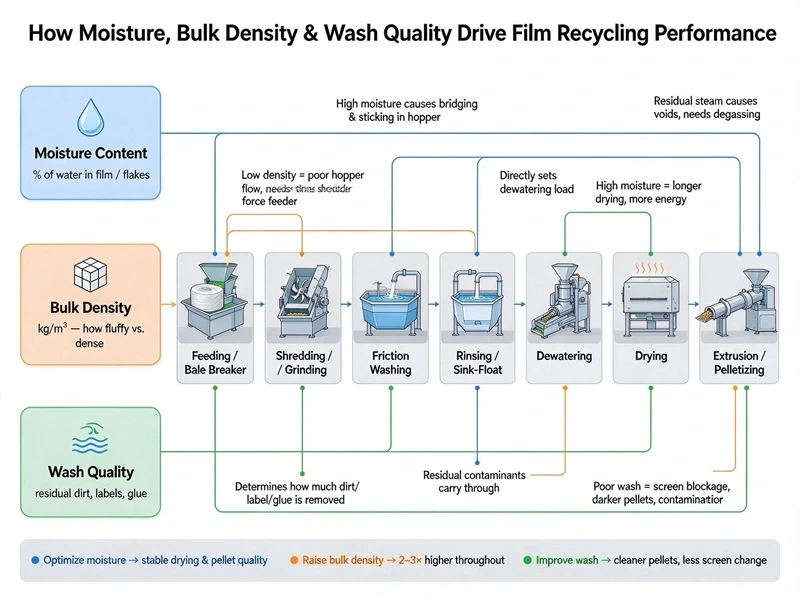
How the Three Variables Interact
Moisture, bulk density, and wash quality are not independent. They interact in ways that affect the overall line design:
-
Moisture affects bulk density — wet film is heavier and may feed differently than dry film
-
Wash quality affects moisture — more washing stages mean more water to remove later
-
Bulk density affects drying efficiency — denser material may dry differently than loose film
A line that performs well on one variable may struggle on another if the configuration is not balanced. This is why supplier discussions should address all three together, using representative material samples.
Pre-Purchase Checklist for Buyers
Use this checklist when evaluating a PE/PP film recycling line proposal:
- Have representative feedstock samples been tested for moisture content?
- Has bulk density been measured on both loose and compacted material?
- Are contamination types and levels identified (labels, sand, organic matter)?
- Does the proposed line include drying stages sized to reach the required moisture target?
- Is the feeding system designed for the actual bulk density range of the feedstock?
- Are washing stages matched to the contamination profile?
- Has the supplier confirmed how the three variables interact for this specific material?
- Are moisture and contamination targets documented for the pellet output?
FAQ
Q: What moisture level should PE/PP film have before pelletizing?
A: For suitable PE film feed with a correctly configured drying route, final moisture before pelletizing is typically planned around 3–5%. Actual targets depend on the specific polymer, film form, and required pellet quality. Buyers should confirm the moisture specification with their supplier based on representative material testing.
Q: Can I run PE and PP film on the same recycling line?
A: PE and PP have different melting behaviors and processing temperatures. While some equipment can handle both, running them together may affect pellet consistency. Many operators run them as separate campaigns with appropriate process adjustments between runs.
Q: What happens if bulk density is too low for the feeding system?
A: If bulk density is lower than the feeding system is designed for, the extruder may receive inconsistent material flow, leading to surging, unstable melt pressure, and variable pellet quality. Densification or a different feeding approach may be required.
Q: How often should I expect to change screen changer filters on a film line?
A: Screen change frequency depends on contamination level, filter mesh size, and throughput. Higher contamination and finer filtration generally require more frequent changes. The washing quality directly affects how often screens need to be changed. Buyers should discuss expected screen change intervals with their supplier based on their specific feedstock.
Q: Is wash quality only about appearance?
A: No. Wash quality affects filtration load, degassing performance, and final pellet consistency. Incomplete removal of labels, adhesives, or organic matter can cause black specks, bubbles, or weak points in the final pellets.
Q: How do I measure bulk density for my film feedstock?
A: Bulk density is typically measured by filling a container of known volume with the material and weighing it, following a standardized procedure. The measurement should be done on representative material at the moisture condition expected during production. Suppliers may request this data to size the feeding system correctly.
Conclusion
Selecting a PE/PP film recycling line is not a matter of comparing equipment lists. The three variables that drive the most important configuration decisions—moisture content, bulk density, and wash quality—should be measured on actual feedstock before technical discussions begin.
The most common mistake buyers make is providing vague feedstock descriptions (“clean PE film” or “mixed film scrap”) without quantifying these three parameters. This leads to proposals that look comparable on paper but perform very differently in practice.
If you are evaluating a film recycling line, start by testing your material for moisture and bulk density, and documenting contamination types. Then explore the cleaning and granulation system configurations that match your feedstock conditions, or discuss your material and production requirements with a technical team that can confirm the appropriate line design.


 Download
Manual
Download
Manual Video
Video



 Connect: