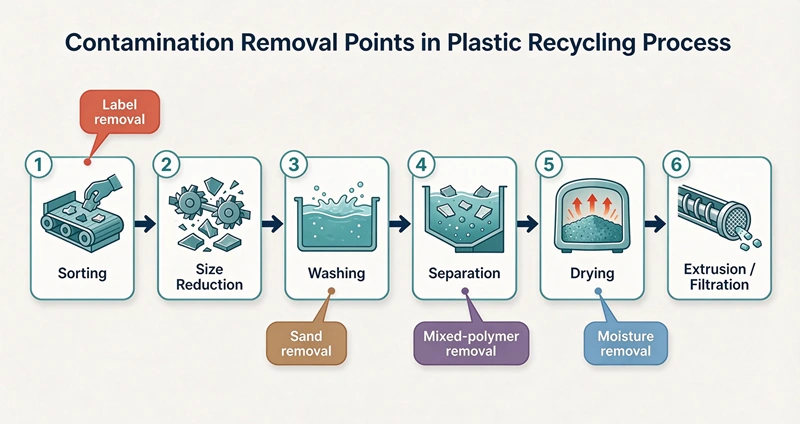
Feedstock contamination is not a single “dirt level.” It is a profile—labels, adhesives, sand, oils, moisture, mixed polymers, metals—and each component triggers a different configuration response. Low-contamination post-industrial scrap may need only size reduction and cold friction washing before pelletizing, while heavily contaminated post-consumer bales typically require multi-stage sorting, hot washing, density separation and finer melt filtration. The configuration changes the cost-per-ton structure: more stages add energy, water, chemicals, wear and reject handling, but skipping them shifts cost to filtration downtime, off-spec pellets and yield loss. The right question is not “how dirty is my material,” but “which contaminants change which module, and which cost drivers follow.”
What “Contamination Level” Actually Means for Line Design
A single percentage figure rarely describes feedstock well enough to configure a line. REHOBOTH’s washing-line selection framework starts with polymer, item form and contamination type, then matches sorting, size reduction, washing, separation and drying duty to the actual material entering the plant. Two feedstocks with the same nominal “5% contamination” can demand very different lines if one is mostly sand and the other is adhesive labels with residual moisture.
Practical buyers should separate contamination into four design-relevant groups.
Surface contamination—dirt, dust, food residue, oils and grease. This mainly drives washing intensity: cold rinse, friction washing, hot washing with detergent, or a combination. Post-consumer rigid containers and PET bottles typically carry labels, caps, adhesives and organic residues that cannot be removed by dry size reduction alone. Post-industrial scrap from a controlled production line may need only a cold wash or no washing before granulation.
Embedded or inseparable contaminants—inks, printed layers, fillers, and multi-material composites. These are not removed by washing. They drive melt filtration and degassing decisions, and sometimes determine whether the material is suitable for mechanical recycling at all. Film with heavy printing requires more filtration and degassing capacity than clean blown film; REHOBOTH’s film line specifically addresses ink, paper and aluminum residues through two-stage hydraulic melt filtration.
Density- and polymer-mismatch contaminants—mixed polymers, caps and rings on PET, metals, glass and sand. These drive separation modules: float-sink tanks, density separation, magnetic or eddy-current metal removal. A rigid washing line that must handle HDPE, PP and residual PET together needs a different separation strategy than a dedicated PET bottle line where the main mismatch is PP caps and labels.
Moisture and volatiles—not “contamination” in the visible sense, but a feedstock condition that interacts with contamination control. Wet flakes increase drying duty and extrusion degassing demand; residual moisture after washing is a recognized variable in pellet quality and line stability. REHOBOTH’s washing-line selection framework explicitly includes drying and moisture target as a configuration decision separate from washing chemistry.
A practical implication: suppliers who quote a line based only on “throughput and material type” without asking for a contamination breakdown are likely to either over-equip low-contamination material—raising fixed and energy costs—or under-equip dirty material—shifting cost to filtration downtime and rejects. A representative feedstock sample is more informative than a single dirt percentage.
How Contamination Pulls Configuration Decisions
The table below is a decision logic, not a product comparison. It shows how increasing contamination complexity typically changes the modules a buyer should discuss with any supplier.
| Contamination profile | Sorting / preparation | Washing | Separation | Melt filtration / degassing | Main cost drivers added |
| Low: clean post-industrial regrind, known polymer, little print | Basic inspection; metal removal; size reduction to consistent flake | Cold friction wash or no washing depending on surface residue | Minimal; polymer already sorted | Single-stage filtration often sufficient; degassing matched to volatiles | Power for size reduction; wear parts; yield loss at size reduction |
| Medium: post-consumer rigid containers, labels, some dirt and mixed caps | Manual or mechanical sorting; label removal consideration; metal removal | Cold + hot or friction washing; detergent may be required | Float-sink for caps, labels and density-mismatched polymers | Two-stage filtration beneficial; screen mesh selected for expected fines | Water heating; wastewater treatment; chemical cost; screen changes; reject disposal |
| High: mixed or wet post-consumer bales, heavy organics, film with ink/adhesive | Multi-step sorting; de-metallization; possibly pre-washing; size reduction matched to bulky or film form | Hot washing with chemistry; multi-stage friction/rinsing; closed-loop water treatment becomes important | Density separation plus targeted polymer separation; fines management | Two-stage or finer filtration; vacuum degassing for inks and volatiles; screen area sized for contaminant load | Energy for heating and motors; water recycling CAPEX/OPEX; filtration consumables; lower yield from rejects and screen purges |
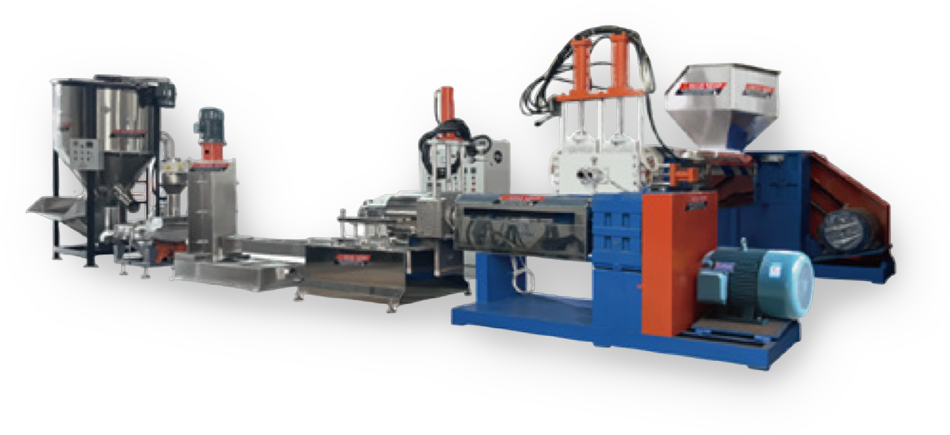
The table explains why “washing line” and “pelletizing line” are not interchangeable product categories. Washing removes surface and density-separable contamination before extrusion; pelletizing converts prepared flake or regrind into pellets, and its filtration and degassing duty depend on what the washing stage did—or did not—remove. REHOBOTH’s rigid pelletizer uses two extrusion stages with hydraulic screen changers at both stages; the first captures larger contaminants, the second provides finer filtration, and the final screen mesh can be selected according to feedstock contamination and pellet end-use. This staged approach is a configuration response to contamination, not a universal specification.
For film feedstock, the relationship is particularly direct: low bulk density and printing/ink residues complicate stable feeding and melt cleanliness. REHOBOTH’s film line combines controlled/forced feeding with two-stage hydraulic filtration to address ink, paper and aluminum particles carried into extrusion. For a buyer, the key confirmation question is not “how many stages,” but “which contaminant does each stage target, and what screen change frequency should I plan for.”
Where Cost per Ton Comes From—and How Contamination Moves It
Cost per ton in mechanical recycling is not a single number a supplier can quote in advance. It is the sum of fixed-cost amortization and variable processing costs divided by accepted output—and contamination affects both the numerator and the denominator. A buyer can build a more realistic estimate by separating cost into the following drivers.
1. Yield and rejects. Contamination that is removed becomes reject, purge or sludge. The higher the incoming non-target fraction, the lower the saleable output per ton of feedstock, and the higher the disposal or treatment cost per accepted ton. Academic work on mechanical recycling cost has emphasized that cost per tonne of product depends on waste composition and that rationalizing processing choices can reduce cost per tonne of product by 15–26% in the cases studied. The exact figure is context-specific, but the direction is consistent: contamination control is also yield control.
2. Energy. Washing temperature, motor load, drying and extrusion all consume energy, and their duty rises with contamination severity and moisture. Hot washing and multi-stage drying are more energy-intensive than cold friction washing; extrusion with high degassing and filtration demand draws more power and may reduce throughput. REHOBOTH’s washing systems incorporate variable-frequency drives and electromagnetic heating to reduce avoidable energy consumption, but the base duty is still set by the feedstock. Buyers should ask for energy estimates at the specific contamination and moisture level they expect, not at a “clean flake” reference condition.
3. Water and wastewater. Washing consumes water, and contaminated wash water requires treatment before reuse or discharge. A closed-loop design can reduce freshwater intake and discharge volume, but the treatment load—filters, settling, possibly chemical dosing—scales with the contamination removed. REHOBOTH offers closed-loop water treatment as an integrated option; whether it is economically justified depends on local water cost, discharge rules and the contamination profile.
4. Wear parts and consumables. Abrasive contaminants—sand, glass, metal fines—accelerate blade, screw and screen wear. Filtration screens and screen-changer consumables are replaced more frequently when contaminant load is high. This is a per-ton variable cost that is easy to underestimate at quotation stage because it depends on operating hours and contaminant abrasiveness, not only on line price.
5. Labor and automation. More sorting, washing and filtration stages create more intervention points: screen changes, reject removal, wash-bath monitoring, dryer adjustment. Automation can reduce labor per ton, but adds CAPEX and maintenance complexity. REHOBOTH’s solutions page lists labor cost and degree of automation as explicit cost-control dimensions, not afterthoughts.
6. Filtration-driven downtime. When melt filtration is undersized for the contaminant load, screen changes become frequent and production stops. The cost is not the screen itself; it is lost throughput and labor during changes. A two-stage or higher-capacity filtration arrangement may reduce change frequency on dirty feedstock, but it also adds pressure drop and cleaning duty. This is a trade-off that should be confirmed with the supplier using representative contaminated material.
A useful buying discipline: ask for a cost-per-ton model that shows yield, energy, water/wastewater, wear parts and labor separately, and then ask how each line item changes if contamination doubles or if moisture after washing rises. A supplier who cannot break the model down is likely quoting a line, not a processing cost.
A Pre-Selection Checklist Buyers Can Use
Before comparing equipment configurations or prices, verify the following with representative samples and site conditions:
- Polymer and form: Is the feedstock a single polymer or a mix? Rigid, film, bottle, woven bag, or mixed? REHOBOTH’s granulation selection starts with polymer type, bulk density, contamination and moisture, and mixed or unknown material requires evaluation before equipment selection.
- Contaminant inventory: List labels, adhesives, caps/rings, metals, sand, organics, oils, inks and mixed polymers separately. Note which are surface contaminants and which are embedded.
- Contamination variability: Is the dirt level stable year-round, or does it swing with supplier, season or bale quality? A line configured for the average may fail at the peak.
- Moisture at the extruder: Define the moisture target after drying and confirm how it will be measured. Residual moisture interacts with contamination and affects degassing duty.
- Required output grade: Clean dry flake for sale, or pellets for internal conversion or an external buyer? Food-contact or high-clarity applications impose tighter contamination limits and may require additional washing/filtration stages.
- Utilities and discharge constraints: Confirm available power, water quality, heating source, drainage and local wastewater rules before selecting washing chemistry and water-treatment scope.
- Wear-part and screen-consumable plan: Ask for expected replacement intervals at the stated contamination level, and price them per ton rather than per year.
- Reject handling: Where do labels, caps, fines, sludge and screen purges go? Disposal cost and environmental compliance belong in the per-ton model.
If any of these cannot be answered with sample-based data, the configuration is still provisional. REHOBOTH’s washing-line framework explicitly treats incoming contamination, required output condition and site utilities as the three inputs that define the line—not a fixed equipment list.
FAQ
Does a higher contamination level always mean a more expensive line?
Not automatically. It usually means a different configuration with more washing, separation or filtration duty, but the total cost depends on throughput, output grade and how much of the contamination can be removed early. A line that removes sand and labels before extrusion may cost more in washing but less in filtration downtime and rejects. The relevant comparison is cost per accepted ton, not equipment price alone.
Can I add a washing line later if my feedstock gets dirtier?
It is technically possible to integrate a washing stage upstream of an existing pelletizing line, but the extruder’s filtration and degassing capacity may become the bottleneck. REHOBOTH’s pelletizing systems are configured around feedstock condition including contamination and moisture, so a later change should be evaluated against the existing extruder’s screen area, degassing capacity and feeding arrangement.
Is hot washing always necessary for post-consumer plastic?
No. Hot washing is typically considered when oils, adhesives, labels or organic residues require elevated temperature and possibly detergent to remove. Post-industrial scrap with only dust or minor surface dirt may be adequately handled by cold friction washing or a simpler rinse. The decision should follow measured contamination and the required output grade, not a default rule.
How does contamination affect pellet quality beyond visible dirt?
Contaminants can affect filtration pressure, degassing load, color and odor, and can accelerate screw and screen wear. Some contaminants also carry moisture or volatiles into the extruder. For applications with tight color or odor requirements, the washing and filtration configuration may need to be more conservative even if visible dirt is moderate. Final suitability should be verified with representative samples and the intended pellet specification.
What is the most common configuration mistake buyers make with contaminated feedstock?
Specifying throughput on clean-material assumptions and then discovering that filtration changes, drying duty and reject handling reduce usable output. A second common mistake is comparing line prices without normalizing for the contamination level each quote was based on. Two quotes for the “same capacity” can describe very different processing duties.
When should a buyer request a feedstock trial or lab assessment?
Before finalizing configuration and commercial terms, especially for mixed, wet or heavily contaminated post-consumer material. A representative sample assessment helps define sorting, washing and filtration duty and reduces the risk of costly redesign after installation.
Conclusion
The most important judgment is not the headline contamination percentage; it is which contaminants change which module—sorting, washing chemistry, density separation, drying, filtration or degassing—and how those changes move yield, energy, water, wear and labor per accepted ton. Buyers should avoid comparing line prices without normalizing for feedstock condition, and should avoid accepting a configuration that has not been checked against a representative sample. When contamination is variable or the output grade is demanding, technical confirmation with sample-based data is necessary before commercial commitment. The next practical step is to review the available washing and granulation configurations against your contaminant inventory, and to discuss the material and production requirements with the supplier so that the cost-per-ton model reflects your actual feedstock rather than a clean-material reference.


 Download
Manual
 Video




 Connect: