Quick answer: There is no universal hour count that tells you when to replace blades, screens or screw elements. The practical approach is condition-based: track what the part is doing to output quality, motor load, and physical dimensions, then replace or repair when a measured signal crosses a threshold tied to your product specification. Blades can often be sharpened or rotated before replacement; screens should be replaced once perforations elongate beyond a defined limit; screw elements require replacement when clearance-driven output loss or melt-quality drift can no longer be compensated. This guide explains what to monitor, how to interpret the signals, and how to turn those observations into a spare-parts plan.
Why a calendar alone does not work
A common mistake in plastic recycling operations is setting replacement intervals by time only. An extruder screw that runs clean, dry regrind may last far longer than the same screw handling washed post-consumer film with residual sand and mineral fillers. A granulator screen processing rigid regrind wears differently from one processing film edge trim. Published maintenance guidance consistently notes that wear-part life depends on material abrasiveness, contamination level, throughput, and how closely the part is monitored—not on a fixed calendar.
The alternative is condition-based planning: define the wear mechanisms, identify the observable signals, set decision thresholds against your product requirements, and record the data so that replacement becomes a planned event rather than an emergency. This does not replace the manufacturer's maintenance schedule; it adds a decision layer on top of it.
The three wear mechanisms behind most part failures
Understanding why a part degrades helps you match the monitoring method to the failure mode.
Abrasive wear is the dominant mechanism for blades, screens, screw flights and barrel walls. Hard contaminants—sand, glass fragments, metal shavings, mineral fillers—scratch and erode surfaces during extrusion and cutting. The result is gradual: edges round, screen holes enlarge, screw-to-barrel clearance widens, and output quality drifts before a catastrophic failure occurs.
Adhesive wear occurs when molten polymer adheres to metal surfaces under heat and pressure, particularly on screw elements and die surfaces. Carbon deposits build up on screw surfaces and die holes, causing unstable extrusion output and black spots in pellets.
Corrosive wear is often overlooked. Residual moisture in under-dried flakes generates steam inside the barrel; combined with alkaline cleaning agents from upstream washing, this can attack nitrided protective layers on screws and barrels. This mechanism is more relevant to washing-and-granulation lines than to dry regrind pelletizing, which is why the target washing system page is a natural reference point for operators running post-consumer feedstock.
Blades: sharpen, rotate, or replace?
Granulator and pelletizer blades do not fail on a fixed date. They fail when the cutting edge can no longer produce the particle geometry or pellet consistency your downstream process requires.
What to monitor
The clearest early indicator is motor amperage at steady output. Rising baseline amperage on the same material and screen configuration usually means the cutting action has shifted from slicing to tearing, which draws more force. Visible chips, cracks, or rounded edges on the cutting edge are direct evidence. Output-side signals—higher fines content, oversized particles in regrind, or inconsistent pellet shape—often appear before an operator notices the blade itself.
The decision rule
Published guidance suggests that tool-steel blade sets can typically be reground on the order of 6 to 10 times before replacement, provided the grinding stays within minimum dimension and hardness-zone limits. The decision logic is:
- Rotate when the blade design provides an alternate approved working edge and the dimensions remain within specification.
- Sharpen when the wear can be removed without exceeding minimum dimensions, hardness zone, or geometry limits.
- Replace when cracks, deep chips, deformation, or accumulated grinding make safe reuse unsuitable.
A practical baseline for common PE/PP applications is knife inspection every 500 to 800 operating hours; harder engineering resins or abrasive-filled materials require shorter intervals. These are starting points, not fixed rules—the correct interval is the one that your amperage trend and output data support.
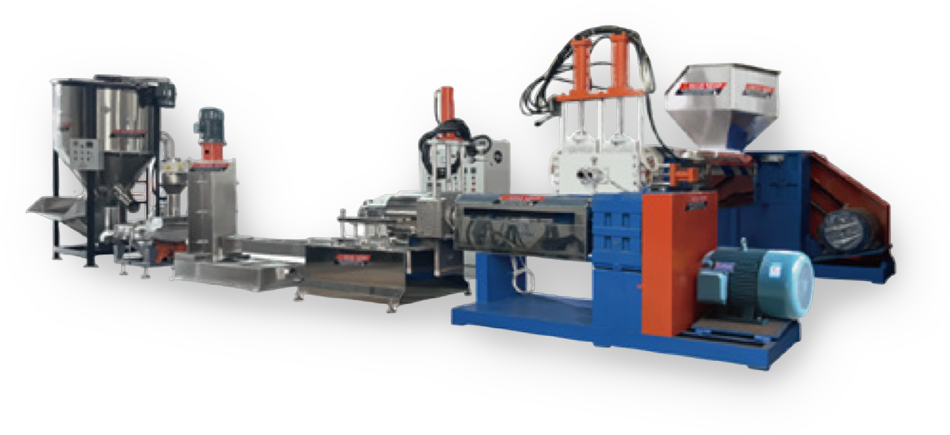
For operators running complete pelletizing systems, the cutting chamber configuration and blade specification should be confirmed against the actual feedstock rather than assumed from a general-purpose setup. Reviewing the available film plastic recycling line configurations or the PET pelletizing setup for washed flakes helps clarify which blade material and geometry the line was specified around.
Screens: when elongation becomes a quality problem
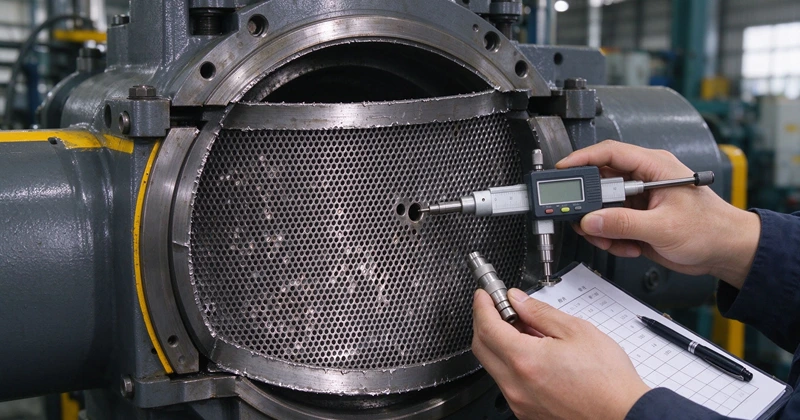
The screen is one of the most commonly overlooked wear parts because it degrades from the inside: particles scour the holes, and the perforations gradually elongate rather than visibly breaking.
What to monitor
Inspect for elongated holes, cracks, thinning of the screen body, and blinding (partial blockage with fines or material). The most useful quantitative threshold is perforation size. Published maintenance guidance indicates that once screen perforations elongate past roughly 110% of their original size, oversized regrind begins to slip through and particle-size control is effectively lost.
The decision rule
A screen that is merely blinded or partially blocked can often be cleaned and returned to service. A screen with perforations beyond the elongation limit, cracks, or visible thinning should be replaced. Rotating the screen front-to-back at planned intervals can even out wear and extend useful life before elongation becomes critical.
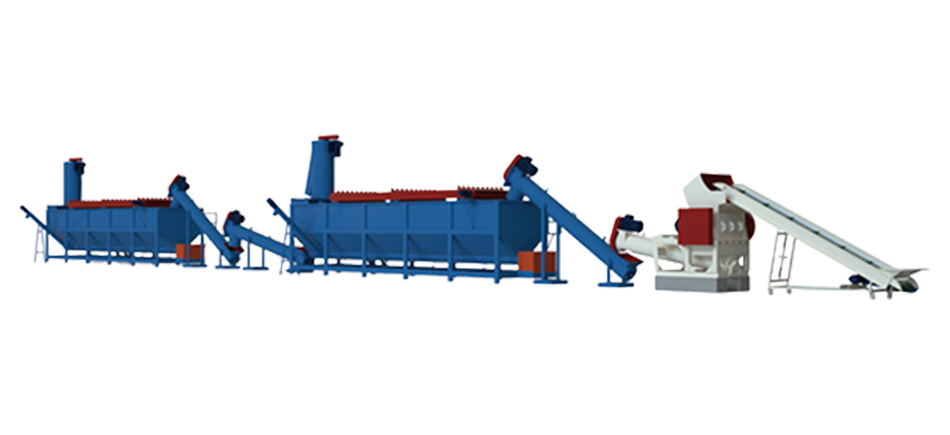
Screen replacement frequency also depends heavily on feedstock cleanliness: washed post-consumer material with residual fines loads the screen differently than clean in-house regrind. For lines where washing and granulation are integrated, the upstream wash quality directly shapes screen life. The washing and granulation recycling system is the relevant reference for understanding how upstream cleaning parameters influence downstream filtration load.
Screw elements: the slowest wear, the highest consequence
Screw and barrel wear is typically the largest recurring wear cost on a recycling line, but it is also the slowest to become obvious. The clearance between screw flight and barrel inner wall widens gradually; the first symptoms are often a decline in output at constant screw speed, rising melt temperature, or inconsistent pellet quality—not a visible defect.
What to monitor
Output at constant screw speed is the most accessible trend. A screw that once delivered a given throughput at a set RPM but now requires higher RPM to maintain the same output is showing clearance-driven loss of conveying efficiency. Melt quality drift—fluctuating melt pressure, unmelted particles, or color streaking—can indicate worn flights or carbon buildup. Abnormal vibration and sudden current spikes may point to bearing wear, misalignment, or foreign objects rather than screw wear itself, and should trigger an immediate stop-and-inspect.
For twin-screw or segmented screw designs, individual conveying or mixing elements may wear faster than the full screw set. Published parts-planning guidance distinguishes between full screw-set replacement and replacement of critical high-wear segments, because the lead time and cost profile differ substantially.
The decision rule
Screw elements are rarely “replaced on schedule.” The decision is driven by whether the wear-induced loss can still be compensated within the acceptable operating envelope. When output at maximum allowable screw speed falls below the line’s required throughput, or when melt quality can no longer meet product specification despite feed and temperature adjustments, a screw inspection and dimensional assessment are warranted. Nitrided screws in non-abrasive applications have been reported to reach service lives in the range of several thousand hours, but abrasive fillers and contaminated feedstock shorten this materially; the actual figure should be confirmed against the specific screw metallurgy and feedstock.
Because screw wear interacts with barrel wear and heating performance, screw-element decisions should be made with the full extruder configuration in view. For rigid regrind applications where screw configuration is already a selection variable, the rigid plastic recycling pelletizer overview provides the relevant configuration context.
Putting the three parts into one planning table
The table below is not a replacement schedule. It is a decision aid: it pairs each part with the signal that matters most and the action that signal supports.
| Wear part | Primary wear mechanism | Most useful monitoring signal | Decision threshold / action logic | Planning implication |
| Granulator / pelletizer blades | Abrasive wear, edge chipping | Motor amperage trend at steady output; edge condition; fines and oversize in output | Rotate if alternate edge available; sharpen if within dimension/hardness limits; replace on cracks, deep chips, or exceeded regrind count | Keep one spare set per blade station; track regrind count per set |
| Screen | Abrasive elongation of perforations; blinding | Hole elongation vs original size; cracks; thinning; throughput decline | Clean if blinded only; replace when elongation approaches ~110% of original or cracks/thinning appear | Stock screens in the apertures used most; rotate front-to-back at planned intervals |
| Screw elements | Abrasive wear of flights; adhesive carbon buildup; corrosive attack | Output at constant screw speed; melt pressure stability; vibration/current anomalies | Inspect when output at max allowable RPM falls below requirement or melt quality drifts despite feed adjustment | For segmented screws, stock critical high-wear segments rather than a full set; confirm lead time before failure |
This structure follows the principle that planned replacement decisions should be tied to measured condition, not only to elapsed hours. It also supports a spare-parts plan that distinguishes between fast-moving, predictable wear items (blades, screens) and slower-moving, higher-consequence items (screw segments, barrel components) with longer manufacturing lead times.
From monitoring to spare-parts planning
Once you have a monitoring routine in place, the planning question becomes: what should be stocked, and at what level?
Blades and screens are predictable-consumption items. Their replacement can be planned by operating hours or processed tonnage, and the cost of carrying one spare set is usually small relative to the cost of a production stop waiting for a blade. Tracking regrind count per blade set turns replacement from a surprise into a scheduled event.
Screw elements and barrel components sit in a different category. They have lower consumption frequency but longer manufacturing lead times. A full screw set is rarely the right stock decision for every plant; for segmented designs, identifying the critical high-wear segments and confirming their lead time with the supplier is a more proportionate approach. The relevant question is not “how many spares can we afford” but “which part would stop the line longest if it failed without a replacement on hand.”
This is also where the distinction between a granulation-only line and an integrated washing-and-granulation line matters. Washing introduces moisture and residual cleaning chemistry into the downstream extrusion environment, which changes the corrosion and adhesive-wear profile of screw elements and screens. Operators running washed feedstock should treat the cleaning and granulation system overview as a starting point for understanding which wear mechanisms are most relevant to their configuration, and confirm the specific spare-parts scope with the equipment supplier rather than assuming a generic list.
A short pre-replacement checklist
- The machine is locked out and the rotor or screw is confirmed at rest.
- The observed signal (amperage, output, particle size, melt pressure) has been compared against a recorded baseline, not just a subjective impression.
- The wear dimension has been measured against the manufacturer’s specification, not a generic value from another model.
- For blades: the remaining regrind count and minimum dimension have been checked before deciding sharpen vs replace.
- For screens: hole elongation has been measured, not estimated visually.
- For screws: feed conditions and temperature settings have been ruled out before attributing output loss to screw wear.
- The spare part number and configuration have been confirmed against the machine’s technical documentation.
A replacement decision made without a baseline is a guess. A decision made against a recorded trend is a planning input.
FAQ
Can I set a fixed replacement interval for all three wear parts?
No single interval applies across blades, screens, and screw elements. Blades and screens respond to operating-hour or tonnage-based planning, while screw elements are better managed through periodic dimensional assessment and output trending. Material abrasiveness and contamination level shift the relevant interval even within the same part type.
How do I know if a blade needs sharpening or replacement?
If the wear can be removed without going below the minimum dimension or hardness zone, sharpening is viable. If cracks, deep chips, deformation, or accumulated regrind cycles have compromised the edge, replacement is the safer decision. The regrind count per set is the most practical planning record.
What is the clearest sign that a screen should be replaced rather than cleaned?
Perforation elongation. A blinded or partially blocked screen can usually be cleaned, but once the holes have enlarged beyond the acceptable limit—published guidance uses roughly 110% of original size as a practical threshold—oversized particles pass through and size control is lost.
Does a worn screw always need to be replaced as a complete set?
Not necessarily. For segmented screw designs, individual high-wear conveying or mixing elements may be replaceable. The decision depends on which elements have worn, whether the wear is dimensional or surface-adhesion related, and the lead time for the specific segment.
How does washed feedstock change wear-part life compared with dry regrind?
Washed post-consumer material can carry residual moisture and cleaning chemistry into the extruder, adding a corrosive dimension to the abrasive wear that dry regrind does not present. Screen loading and screw-surface condition should be monitored with that in mind.
Where can I confirm the correct spare-part specification for my line?
The spare-part specification should come from the machine’s technical documentation and the equipment supplier, not from a generic wear-part list. For integrated washing and granulation configurations, confirming the part number against the system’s original configuration avoids fit and clearance mismatches.
Conclusion
The most important judgment standard is not a number of hours—it is whether the part’s condition still supports the output quality and throughput your line was designed to deliver. Blades fail by degrading cut quality and raising amperage; screens fail by elongation that lets oversize particles through; screw elements fail by gradual clearance loss that shows up as output decline or melt instability before any visible defect. The mistake to avoid is treating replacement as a calendar event or waiting for a breakdown. Condition-based monitoring, recorded against a baseline, turns wear parts from an emergency expense into a planned operating cost.
When the monitoring data points to a replacement decision, the next step is to confirm the part specification against the actual line configuration—not a generic list. For lines that combine washing and granulation, reviewing the cleaning and granulation system configuration and discussing the specific wear-part scope with the supplier is the appropriate technical confirmation step.


 Download
Manual
 Video




 Connect: