A commissioning checklist for a plastic recycling line should verify four layers in sequence: cold mechanical and safety conditions, thermal equilibrium of the extruder and die, stable extrusion-to-pelletizing linkage under representative feedstock, and—where a washing section exists—dewatering and water-loop performance. Passing a factory acceptance test does not automatically clear the line for production; site conditions, utility quality, and integrated line behavior must be confirmed separately before first production is released.
Most commissioning problems are not caused by a single broken component. They come from gaps between what was proven at the factory and what exists on site: a motor that ran in the supplier’s hall but draws unexpected current on a different power supply, a die that heated evenly in a controlled environment but shows zone-to-zone deviation after a long uncrated stand, or a dewatering section that performs on a small sample but not at the material loading the line will actually see. The checklist below is organized so that each layer closes before the next begins. It is not a substitute for the supplier’s commissioning procedure; it is a buyer-side verification framework for asking the right questions and recording the right evidence.
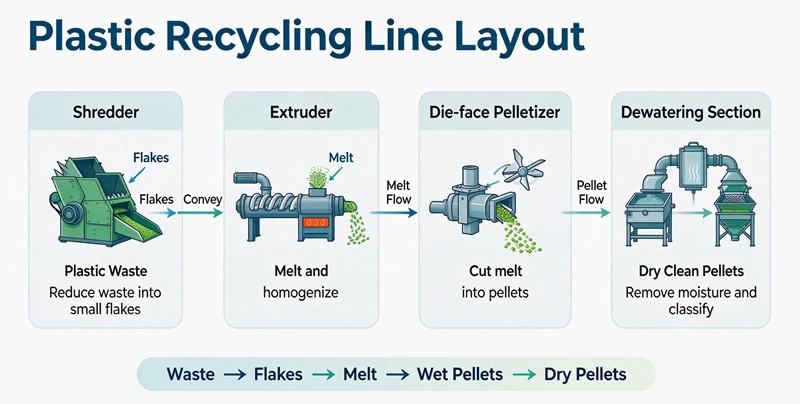
Layer 1 — Cold checks: mechanical, utilities and safety
Cold checks are the only opportunity to identify conditions that heat and motion can hide. They should be completed and signed off before any barrel zone is energized.
Mechanical alignment and anchoring. The extruder and main drive should be leveled and aligned per the supplier’s tolerances. Coupling alignment between motor and gearbox is a common source of vibration that only becomes visible at operating temperature; a cold alignment record provides the baseline for any later thermal re-check. Anchor bolts, shims, and foundation isolation should be confirmed before the first heat cycle.
Guard and interlock verification. Every guard should be in place, and every interlock should be functionally tested—not merely observed as installed. The test should confirm that the line cannot start, or cannot continue running, when a guard is open or a safety device is triggered. Interlocks that can be bypassed for convenience during commissioning should be documented as temporary deviations with a named owner and a closure date. Emergency stops should be accessible from all operating positions, and the stop response should be verified under control power, not only by visual inspection.
Utilities quality. Power supply voltage, phase rotation, and earth continuity should be measured at the main distribution point and at the line. Cooling-water flow and pressure should be confirmed at the extruder, die, and pelletizer before any melt is introduced. Compressed-air quality for pneumatic conveying and cylinder actuation should be dry and oil-free; moisture or oil carryover found at this stage is far easier to correct than after it has contaminated a die face or a conveying line.
Rotation and no-load direction. Screw rotation, cutter rotation, and pump rotation should be confirmed with the drive uncoupled or in a safe no-load condition. A wrong direction discovered under load can damage screw elements or cutter hardware before the first barrel of material is processed.
Layer 2 — Thermal checks: heat soak and die temperature distribution
Thermal checks answer a different question from cold checks: not “does it turn,” but “is the metal at the setpoint throughout its mass, not just at the surface.”
Barrel heat soak. After all barrel zones reach setpoint, the extruder should be held at temperature for a defined soak period before the screw is started. The required soak time depends on machine size and barrel mass; small machines may equilibrate in roughly 20–30 minutes, while larger barrels may need substantially longer. The point of the soak is to eliminate the difference between the heater-band surface temperature and the temperature of the barrel wall and screw. Starting the screw before that equilibrium is reached can produce a false torque reading or uneven melting in the first minutes of operation.
Die-plate zone-by-zone verification. For die-face pelletizing, the die plate should be checked zone by zone. A die that reads correctly at the controller but shows a cold band near the outer holes will produce frozen or partially frozen holes at startup, particularly on the first run when melt flow is still stabilizing. The commissioning record should note the actual indicated temperature of each zone and the soak duration at the die, not only the barrel.
Heater and thermocouple response check. Each heater zone should be observed during heat-up for rate of rise and stability at setpoint. A zone that overshoots and then oscillates, or one that takes markedly longer than its neighbors to reach setpoint, is worth resolving at commissioning rather than during a production run. Thermocouple placement should be confirmed against the supplier’s drawing; a thermocouple reading the heater band rather than the barrel wall can make a cold barrel appear hot.
Layer 3 — Extrusion and pelletizing linkage under representative feedstock
This is the layer where single-machine verification gives way to line behavior. A pelletizer that produces acceptable pellets on a small, clean sample may behave differently when the upstream feed rate, melt pressure, and melt temperature are the ones the line will actually run at.
Representative feedstock run. Commissioning should use a feedstock that represents the material the line was configured for—polymer type, form, bulk density, and contamination level. Running on a convenient clean sample proves the machine can make pellets; it does not prove the line can make pellets from the material the buyer purchased the line to process. The run should be long enough to reach steady-state melt pressure and temperature, not merely long enough to see pellets emerge.
Melt pressure and temperature stability. During the representative run, melt pressure and melt temperature should be logged at intervals. The acceptance question is not whether a single reading falls within a range, but whether the readings are stable over the run duration. A slowly climbing melt pressure may indicate screen loading, a die-hole restriction, or a feed-rate mismatch; a fluctuating melt temperature may point to heater control or screw-speed interaction. These are commissioning findings, not production adjustments to be deferred.
Pelletizing start-up sequence. The die-face start-up should follow the supplier’s interlocked sequence. The cutter should be brought to speed before melt is introduced, or per the supplier’s specified order, and cooling-water flow should be confirmed at the die face before extrusion begins. If the line uses underwater pelletizing, cooling-water temperature at the die is a primary variable for pellet quality and die-hole freeze-off; it should be recorded at the start of the run and at steady state.
Pellet quality evidence. Commissioning records should include a physical sample or a documented observation of pellet form: whether pellets are fused, whether fines are excessive, whether dimensions are consistent, and whether any die holes are producing irregular strands. These observations are more useful at commissioning than a later production complaint, because the corrective action can still be assigned to installation or start-up parameters rather than treated as a material problem.
Layer 4 — Washing-line commissioning: dewatering, water loop and mechanical wear
Where the scope includes a washing section, commissioning must confirm that the line can deliver dry flakes at the intended condition, not merely that water flows through the washers.
Friction-washer and dewatering mechanical checks. Rotor paddles, screen baskets, and dewatering press components should be inspected for clearance and wear before production material is introduced. The commissioning run should confirm that the dewatering section discharges flakes at a moisture level compatible with the downstream use or pelletizing step. Moisture carryover that is acceptable in a short trial can become a downstream extrusion problem at steady state, particularly for PET or hygroscopic materials.
Water-loop balance. The water treatment and circulation loop should be checked for flow balance between washing stages, temperature control where hot washing is used, and the condition of the final rinse. Commissioning should record whether the loop is operating as a closed or partially closed system, and what the make-up water and discharge points are. A water loop that is hydraulically balanced but not thermally stable will produce inconsistent washing, which may only show up as downstream pellet contamination or IV loss.
Interface to granulation. The flake transfer from drying to the granulation feed should be confirmed at the material loading the line will run. A transfer system that works at low rate but chokes or segregates at target rate is a commissioning open item, not a production learning.
Table 1 — Commissioning layers and release criteria
| Layer | What is verified | Typical evidence to record | What should not be released on this evidence alone |
| Cold checks | Alignment, guards, interlocks, E-stop response, utilities | Alignment record; interlock test log; utility readings at line | Thermal behavior; melt stability; integrated line rate |
| Thermal checks | Heat soak duration; die zone distribution; heater response | Zone-by-zone temperature log; soak start/end times | Extrusion stability under load; pellet quality |
| Extrusion–pelletizing linkage | Representative-feedstock run; melt pressure/temperature stability; start-up sequence; pellet form | Run log; melt trend; pellet sample or observation record | Long-run rate; wear life; full material compatibility |
| Washing-line checks | Dewatering performance; water-loop balance; transfer at target rate | Moisture observation; flow/temperature record; transfer observation | Downstream pellet quality at steady state |
Table 2 — Common pre-production findings and their likely source layer
| Finding before first production | Likely layer | What it usually points to |
| Vibration or unusual noise at first rotation | Cold checks | Coupling alignment, anchoring, or drive train condition |
| Torque or current higher than expected on empty screw | Thermal checks | Insufficient heat soak or a zone not at true temperature |
| Some die holes freeze at start-up | Thermal checks / linkage | Die zone distribution or start-up sequence timing |
| Melt pressure drifts upward during the run | Linkage | Screen loading, feed-rate mismatch, or die restriction |
| Pellets fused or excessive fines on first run | Linkage | Cutter speed, cooling-water temperature, or melt temperature at die |
| Flakes leaving dewatering wetter than expected | Washing-line checks | Dewatering clearance, screen condition, or transfer loading |
Checklist: before releasing the line to first production
- Cold alignment record signed and compared against supplier tolerance
- Every guard installed and every interlock functionally tested, with temporary bypasses documented and owned
- Emergency-stop response verified from all operating positions
- Power, cooling water, and compressed-air quality measured at the line
- Barrel soak time defined and completed before screw start
- Die-plate zone temperatures recorded zone by zone at soak completion
- Representative feedstock run completed to steady-state melt pressure and temperature
- Melt pressure and temperature logged over the run, not only at a single point
- Pelletizer start-up sequence followed per supplier interlocked procedure
- Pellet form, fines, and die-hole behavior recorded
- Dewatering moisture and water-loop balance recorded where washing is in scope
- Open-item list closed or formally transferred to SAT with named owners and dates
FAT is not SAT: what to hold for site acceptance
A factory acceptance test proves that the contracted factory scope operates under the supplier’s conditions. It does not prove that the line will perform on the buyer’s site, with the buyer’s utilities, feedstock variability, and operating staff. Commissioning is the bridge, and SAT is the formal closure of that bridge.
Items commonly left open at FAT and requiring site verification include: final utility quality at the line, site-specific foundation and alignment conditions, integrated line behavior across modules that were tested separately at the factory, operator response under the buyer’s shift structure, and the actual feedstock stream rather than a nominated sample. A commissioning record that does not distinguish between “closed at FAT” and “closed at SAT” tends to produce a false sense of completion.
The practical rule is: do not treat a successful cold run or a short pellet sample as production release. Release should follow a signed open-item list in which every item is either verified, accepted with a defined limitation, or assigned to a post-start monitoring plan.
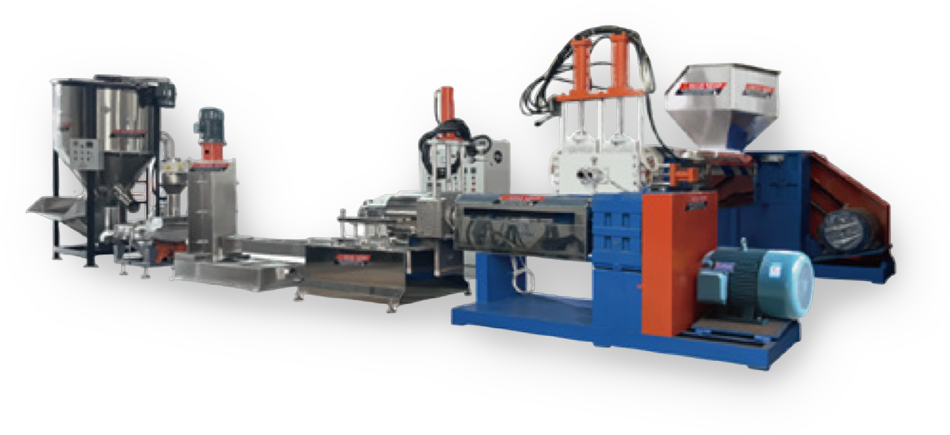
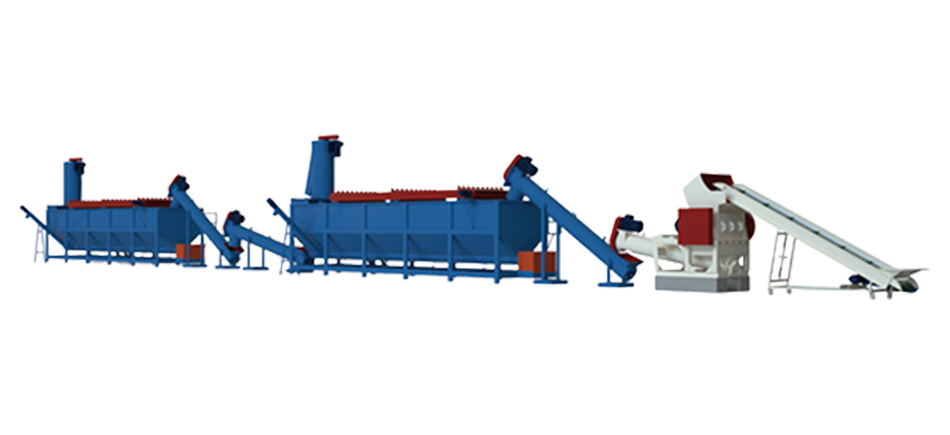
For buyers who need to align commissioning scope with the line configuration they have selected, the available granulation system configurations and the cleaning and granulation system configurations set out the module boundaries that the checklist should follow. Where installation, testing, and operator training are part of the supply scope, the service arrangement should be read alongside the commissioning plan so that responsibilities for each verification step are explicit before the first run.
FAQ
Does a factory acceptance test cover the same items as commissioning?
No. A FAT confirms the contracted factory scope under supplier conditions. Commissioning verifies the line on the buyer’s site with the buyer’s utilities, feedstock, and operating arrangements. Items such as final utility quality, site alignment, and integrated line behavior at target rate are normally site-verification items even when a FAT has been passed.
How long should the extruder soak before the screw is started?
The soak time depends on barrel size and mass. A small machine may equilibrate in roughly 20–30 minutes after reaching setpoint; a larger barrel may require substantially longer. The commissioning record should state the soak duration actually used, because starting the screw before the barrel mass has equilibrated can produce misleading torque and melt-temperature readings.
What is the most common pelletizing finding on first production?
Die-hole freeze-off and uneven pellet formation at start-up are common, and they usually trace to die-plate zone distribution, start-up sequence timing, or cooling-water conditions at the die rather than to a single failed component. Recording zone temperatures and start-up sequence at commissioning gives a baseline for distinguishing a start-up issue from a later material or wear issue.
Should the washing line be commissioned before or after the pelletizing section?
Where both are in scope, the washing and dewatering section should be verified sufficiently to deliver flakes at the intended moisture condition before the pelletizing section is asked to run at steady state. Dewatering performance that is acceptable in a short trial can become a downstream extrusion problem at production rate.
What belongs on a commissioning open-item list?
Anything that is not verified at the time of the commissioning run, including temporary interlock bypasses, utility readings outside the agreed range, feedstock conditions not yet representative, and interfaces between modules tested separately. Each item should have a named owner, a closure criterion, and a target date; items not closed before first production should be transferred to a post-start monitoring plan with a defined review point.
Conclusion
The most important commissioning judgment is not whether the line runs, but whether each layer—cold condition, thermal equilibrium, extrusion–pelletizing linkage, and washing/dewatering where applicable—has been verified against evidence rather than assumption. The most common error is treating a successful cold run or a short pellet sample as permission to start production. Technical confirmation is needed whenever the feedstock used at commissioning does not represent the production stream, when utility readings sit outside the agreed range, or when an interlock has been bypassed for any duration. The next practical step is to compare the commissioning checklist against the actual line configuration and the supply-scope responsibilities for installation, testing, and training, so that no verification item falls between supplier and buyer.


 Download
Manual
 Video




 Connect: