Most plastic recycling projects that underperform do not fail because the equipment was cheap or poorly built. They fail because the buyer and the supplier were solving different problems. Before you compare machines, you need to answer seven questions that define what your system must actually do. These questions cover feedstock, capacity, output specification, process route, cost structure, site readiness, and acceptance criteria.
Getting these answers right before you request a quote can reduce rework, avoid over-specification, and prevent the most expensive mistake in recycling equipment procurement: buying a line that cannot process the material you actually have.
1. What exactly is your feedstock?
This is the first question because it determines everything else—process route, equipment configuration, capacity, and cost. “Plastic waste” is not a specification.
You need to define three layers:
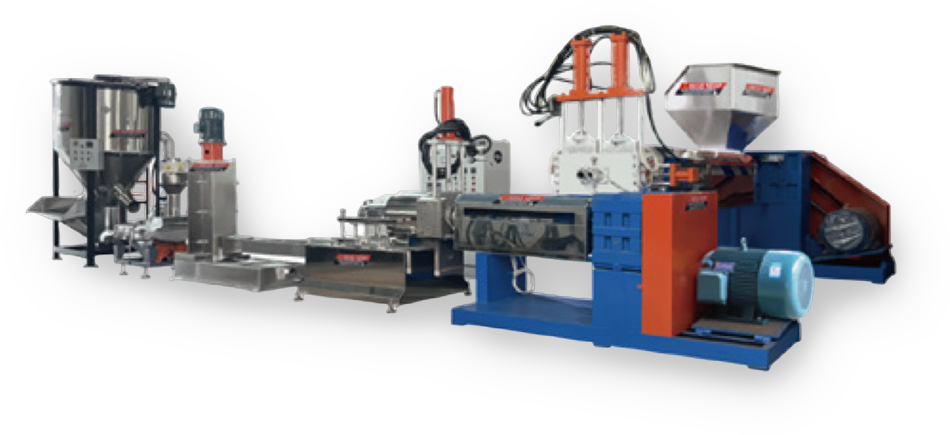
Polymer type and form. Are you processing PE film, PP woven bags, rigid HDPE containers, PET bottles, or a mixed stream? A film line and a rigid pelletizer are not interchangeable. REHOBOTH’s system family is organized around this first distinction: film lines for low-bulk-density flexible scrap, rigid pelletizers for sorted regrind, and PET pelletizers for prepared flakes.
Contamination profile. Labels, adhesives, sand, oil, moisture, metal, and mixed polymers all affect the required washing stages, filtration demand, and degassing capacity. A line built for clean post-industrial scrap cannot handle heavily contaminated post-consumer waste without modification.
Consistency and variability. Will your feedstock be consistent week to week, or will the polymer mix and contamination level shift seasonally? This determines how much process flexibility the line needs and whether you need intermediate buffer capacity.
A practical starting point: collect representative samples, document their polymer composition and contamination level, and ask the supplier to confirm the line design against those samples—not against a generic material description.
2. What is your required output, and how do you calculate it?
Capacity discussions fail when buyers quote a “nameplate” throughput figure without defining what that number means.
There is a difference between input capacity (how much material enters the line per hour) and saleable output (how much qualified product exits the line). The gap between them includes moisture, residue, labels, reject fines, and material lost during processing.
Define these three numbers:
-
Target saleable output (the kilograms of pellets or clean flakes you need per hour)
-
Expected yield (the percentage of input material that becomes saleable output—this must be estimated from representative trials)
-
Operating hours (how many hours per day and days per year the line will run)
Then work backward: required design input = target saleable output ÷ expected yield ÷ planned operating availability. This approach is more reliable than choosing from fixed capacity bands.
Also consider whether you need growth margin. A line that exactly matches today’s volume will become a bottleneck if your feedstock supply increases. A typical approach is to size for current peak volume with a reasonable margin for future expansion, but over-sizing wastes energy and floor space.
When you discuss capacity with a supplier, ask them to confirm what the rated figure represents: input or output, under what feedstock conditions, and at what operating availability.
3. What will the output pellets or flakes be used for?
The intended end use determines the required output quality and, therefore, the complexity and cost of the line.
If the pellets will go into low-grade applications such as thick-walled injection molding or non-food packaging, moderate contamination and color variation may be acceptable. The line can use simpler filtration and fewer washing stages.
If the pellets must meet food-contact requirements, fibre-grade specifications, or bottle-to-bottle recycling standards, the line needs more rigorous controls: multi-stage hot washing, fine filtration, precise degassing, and tighter moisture targets.
The key point: do not specify “food grade” as a machine feature. In regulated markets such as the EU, recycled plastic intended for food contact is subject to requirements for input control, recycling process validation, decontamination, and quality assurance—not just equipment selection. The equipment is one part of a compliance chain that includes feedstock sourcing, process monitoring, and output testing.
Write down the output specification you need, including polymer purity, moisture content, contamination limits, and particle size distribution. Then ask the supplier to confirm the line can achieve it under your actual feedstock conditions.
4. What process route does your feedstock require?
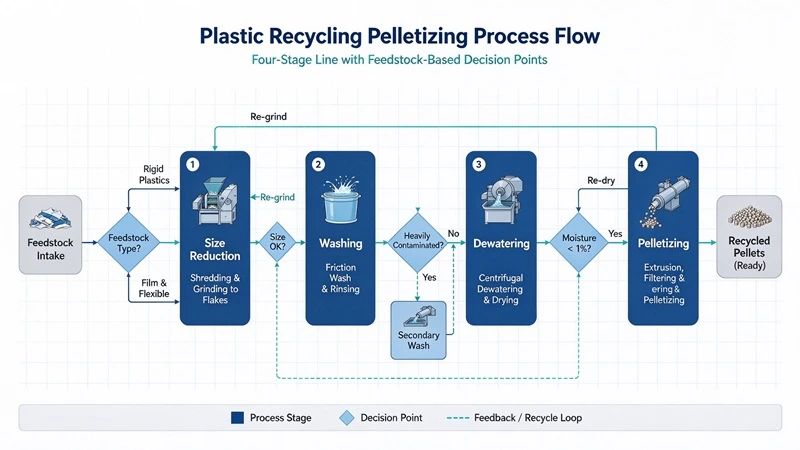
A complete waste plastic recycling system typically includes four sequential stages: size reduction → washing (if needed) → dewatering/drying → pelletizing. Not every feedstock needs every stage.
Post-industrial clean scrap (e.g., factory floor trimmings of known polymer) may skip washing entirely and go directly to a pelletizer. REHOBOTH’s rigid plastic recycling pelletizer is designed for this scenario—processing sorted regrind directly into pellets.
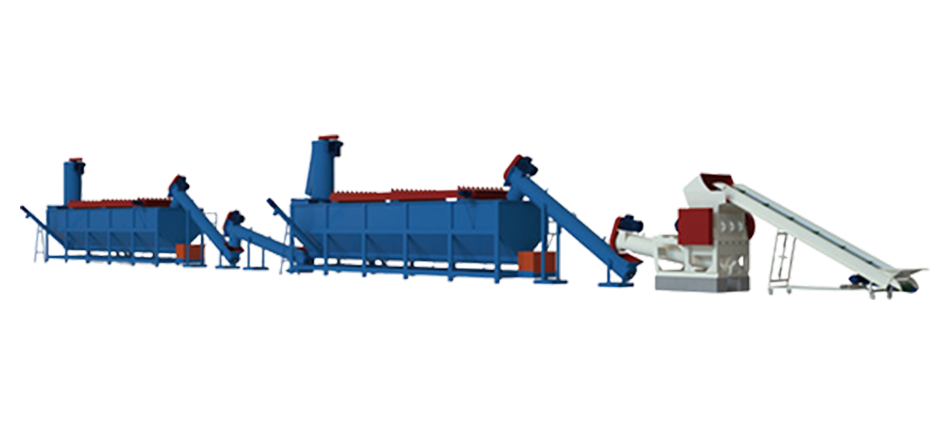
Post-consumer heavily contaminated waste requires a washing line before pelletizing. The washing configuration depends on the contamination type: labels and adhesives need hot washing and friction washing stages; sand and heavy contaminants need density separation; mixed polymers need float-sink separation.
Film and flexible materials create specific challenges at the feeding stage. Low bulk density causes bridging and inconsistent feed into the extruder. A cutter-compactor or compaction feeding system is typically required to densify the material before extrusion.
The decision logic is: start with feedstock form and contamination level, then define the minimum process stages needed, then confirm the configuration against your output specification. A line with unnecessary stages increases capital cost and operating complexity; a line missing a required stage will produce substandard output or fail to run reliably.
5. What drives the total cost, and what is often underestimated?
The purchase price of the main equipment is only part of the project cost. Buyers who focus only on the equipment quotation often underestimate the full investment by a significant margin.
Capital cost factors:
-
Equipment scope: A standalone shredder and a complete washing-plus-pelletizing line are different investment tiers. The configuration of washing stages, filtration, degassing, and automation level drives the equipment cost.
-
Component quality: Motors, gearboxes, screw materials, and screen changers from established brands have higher upfront cost but different wear characteristics and service life compared to generic components.
-
Site infrastructure: Electrical supply, water supply and treatment, drainage, foundations, and installation work are typically not included in the equipment quotation and must be budgeted separately.
Operating cost factors:
-
Wear parts: Screens, blades, filters, and screw elements are consumables. Their replacement frequency depends on feedstock abrasiveness and contamination level. Buyers should ask the supplier to identify the main wear parts and their expected replacement intervals under stated operating conditions.
-
Energy: Motors, heaters, and water systems consume electricity. Electromagnetic heating technology, for example, is designed to reduce heating energy consumption compared to traditional resistance heating, but the actual saving depends on the specific heating duty and operating pattern.
-
Labor: The degree of automation determines how many operators are needed per shift. A fully automated line reduces labor but increases the initial investment.
-
Waste and byproduct handling: Rejected fines, wastewater solids, and non-plastic contaminants all have disposal costs that vary by location and local regulations.
A practical approach: ask the supplier for a total cost of ownership framework that lists equipment, installation, wear parts, energy, labor, and waste handling separately. Compare quotes on the same basis rather than on headline equipment price alone.
6. Is your site ready for the system?
Equipment selection and site readiness are parallel decisions. A line that fits your feedstock and capacity requirements may still fail to install or operate efficiently if the site cannot support it.
Confirm these before finalizing the equipment configuration:
-
Power supply: Total connected load, voltage, and whether the available supply can handle the peak demand of the line. Large motors and heaters have significant starting and continuous loads.
-
Water supply and drainage: Washing lines require substantial water volume and a drainage system for wastewater. If the site has limited water supply or no treatment capability, the washing configuration must be adapted accordingly.
-
Floor space and ceiling height: The line footprint includes not just the main machines but also conveyors, buffer zones, and maintenance access. Some equipment—particularly vertical dryers or tall extruders—has significant height requirements.
-
Material flow logistics: How will feedstock arrive at the line, and how will finished pellets be stored and shipped? The upstream and downstream interfaces are part of the system design.
-
Local environmental requirements: Wastewater discharge, air emissions, and noise may be subject to local regulations. These requirements can affect the choice of washing stages, exhaust treatment, and noise enclosure.
The cost of adapting a site after the equipment is ordered is typically higher than adapting the equipment specification to the site constraints from the beginning.
7. How will you verify performance before and after delivery?
The final question is about acceptance. How will you know the system performs as agreed?
Before the order, request that the supplier confirm the line configuration against a written specification that includes:
-
Feedstock description (polymer, form, contamination, moisture)
-
Required output rate and output quality parameters
-
Site utility conditions (power, water, space)
-
Applicable safety and environmental requirements for your location
During manufacturing, ask what factory testing will be performed and what test report you will receive. Factory acceptance testing on representative material is more meaningful than testing on clean, ideal feedstock.
After installation, define the commissioning and acceptance procedure:
-
What material will be used for the performance test?
-
How long will the test run?
-
What parameters will be measured and recorded?
-
What constitutes pass or fail?
A clear acceptance protocol protects both the buyer and the supplier. It turns a subjective “does it work” discussion into a measurable verification against agreed specifications.
Quick Pre-Purchase Checklist
Use this checklist before requesting a quotation from any recycling equipment supplier:
- Feedstock polymer type and form documented with representative samples
- Contamination profile identified (labels, adhesives, sand, metal, moisture, mixed polymers)
- Required saleable output (kg/h) and operating hours defined
- Intended end use of pellets or flakes documented
- Process route (size reduction → washing → drying → pelletizing) confirmed against feedstock
- Site power, water, drainage, floor space, and height conditions measured
- Total cost framework requested (equipment + installation + wear parts + energy + labor)
- Written output specification prepared for supplier confirmation
- Factory acceptance test and commissioning protocol agreed
- Local environmental and safety requirements identified
FAQ
What is the most important question to answer before buying a recycling system?
Feedstock definition. Polymer type, form, and contamination level determine the required process route, equipment configuration, capacity, and cost. A system designed for clean post-industrial rigid scrap will not perform as expected on heavily contaminated post-consumer film waste. Start with the material, not the machine.
How do I calculate the capacity I need?
Define your target saleable output per hour, estimate the yield from your specific feedstock, and account for planned operating hours. Required design input = target output ÷ yield ÷ operating availability. Ask the supplier to confirm whether the rated capacity refers to input or output and under what feedstock conditions.
Can one recycling line process both film and rigid plastics?
Generally, no. Film and rigid materials require different feeding systems, screw configurations, and sometimes different washing stages. A line optimized for one material form will typically underperform on the other. If you need to process both, consider whether a dedicated line for each material or a compromise configuration—with clearly understood performance limitations—is the better approach.
What is typically not included in an equipment quotation?
Installation, commissioning, electrical work, water infrastructure, foundations, and civil works are often quoted separately. Wear parts, operator training, and ongoing technical support may also be separate line items. Ask for a complete scope list so you can compare quotes on the same basis.
How can I verify output quality before committing to a purchase?
Request factory testing on representative feedstock samples and review the test report before shipment. Define the output specification (polymer purity, moisture, contamination limits, particle size) in writing and include it in the acceptance protocol. If possible, visit a reference installation processing similar material.
What happens if the system does not meet the agreed output specification?
This should be addressed in the contract before the order. Define the acceptance test procedure, what parameters will be measured, and what remedies apply if the system does not meet specification. A clear protocol protects both parties and avoids disputes after installation.
Conclusion
The seven questions in this guide are not hypothetical. They reflect the decision points that most often determine whether a waste plastic recycling project meets its financial and operational targets. The most common mistake is buying a system before defining the feedstock, capacity, and output specification with enough precision. The second most common mistake is underestimating the site infrastructure and operating cost that sit outside the equipment quotation.
If you can answer these seven questions clearly before you contact a supplier, you will be in a much stronger position to compare configurations, evaluate quotations, and avoid the rework costs that come from mismatched expectations.
To explore how different system families are configured for film, rigid, and PET feedstocks, review the waste plastic recycling and granulation system overview. For washing-focused configurations, see the cleaning and granulation recycling system. When you are ready to discuss your specific material and production requirements, the REHOBOTH technical team can help you evaluate which configuration fits your conditions—describe your waste plastic requirements and the team will respond with a tailored assessment.


 Download
Manual
Download
Manual Video
Video



 Connect: