If you are reading this, you are likely considering setting up a plastic recycling factory — or perhaps you have already started and realized there is more to it than just buying a granulator.
The short answer: Planning a one-stop plastic recycling factory starts with your feedstock, not your equipment. Before you look at any machine specification, you need to know exactly what material you will process, how much, and what quality of pellets you need to produce. Everything else — the floor plan, the equipment configuration, the utility requirements, and the budget — flows from these answers.
This guide walks you through the key stages of factory planning, from feedstock assessment to layout design and equipment integration. It does not replace a detailed engineering study, but it gives you a framework to ask the right questions before you commit capital.
Step 1: Start with a Feedstock Audit — Before You Look at Any Machine
The single most common mistake in recycling factory planning is choosing equipment before fully understanding the input material. As one industry observer put it, the key is to buy the most appropriate technology for your specific waste stream, not the absolute best technology on the market.
Your feedstock determines nearly every subsequent decision:
-
Polymer type: Are you processing PP, PE, PET, PS, ABS, PA, PVC, PC, or a mix? Each polymer has different melting temperatures, moisture sensitivity, and processing requirements. A granulation system designed for PET, for example, needs precise IV (intrinsic viscosity) control to produce food-contact grade pellets.
-
Physical form: Is your material film, rigid scraps, flakes, or woven bags? Film requires different handling — crushing, compacting, and degassing — compared to rigid regrind.
-
Contamination level: Is your material post-industrial (clean, homogeneous) or post-consumer (mixed, wet, heavily contaminated)? Post-consumer waste often requires additional washing and separation stages.
-
Moisture content: Wet plastic can cause jams and quality issues. If your input contains trapped moisture, you may need pre-drying or vacuum venting in the extrusion stage.
-
Throughput requirement: What is your reliable, year-round feedstock supply? Specifying a line for 2,000 kg/hr when your supply is consistently 1,200 kg/hr creates inefficiencies in process control and energy consumption.
What to do: Collect a representative sample of your actual feedstock — not a lab-prepared batch. Run basic tests: moisture content, contamination type and level, and polymer identification. This data becomes the foundation of your entire factory plan.
Step 2: Define Your Output Specifications — Know What You Are Selling
Once you know what goes in, define what needs to come out. Your pellet quality targets determine the complexity of your processing line.
Key output specifications to define:
-
Purity level: Do you need 99%+ pure pellets for film-grade applications, or is a lower purity acceptable for injection molding of non-critical parts? REHOBOTH's heat treatment process can achieve up to 99.95% purity in an oxygen-free environment.
-
Pellet size and uniformity: Different downstream processes require different pellet dimensions.
-
Color and appearance: If you are producing white or light-colored pellets, you need more rigorous contamination control.
-
Application: Are your pellets going into food-contact packaging, automotive parts, construction materials, or general-purpose products? Food-contact applications require the highest purity standards.
Your output specifications directly influence your equipment choices — particularly the type of filtration, degassing, and washing stages you need.
Step 3: Understand the Core Process Flow
A complete plastic recycling and granulation system follows a logical sequence of unit operations. Understanding this flow helps you plan your factory layout and identify where each piece of equipment fits.
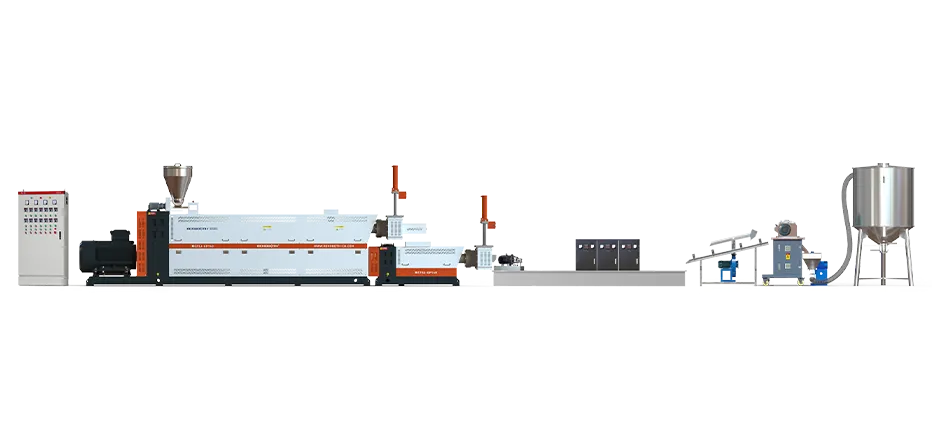
A typical granulation production line includes:
-
Belt conveyor — feeds material into the system
-
Extruder feeding — introduces material to the main extruder
-
Main extruder — melts and homogenizes the plastic
-
Vacuum degassing — removes moisture and volatiles
-
Filter screen — removes contaminants from the melt
-
Die face cutting machine — cuts the melt into pellets
-
Vibrator — separates and cools pellets
-
Packaging — bags or boxes the finished pellets
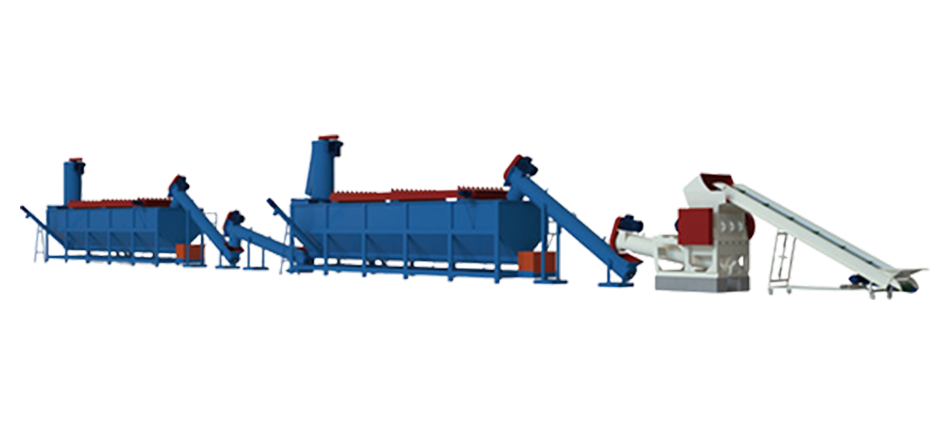
Depending on your feedstock, you may also need upstream equipment (shredders, crushers, washing systems) and downstream equipment (dryers, storage silos, packaging lines).
REHOBOTH's systems are designed for easy integration with existing production lines — both upstream (mixing/feeding) and downstream (drying/packaging) — as well as future planned expansions.
Step 4: Plan Your Factory Layout
Once you have defined your feedstock, output, and process flow, you can begin planning the physical layout.
Key layout considerations
| Consideration | What to Evaluate |
| Material flow | Material should move in a straight line from receiving to storage, minimizing cross-contamination and handling |
| Space requirements | Account for equipment footprint, maintenance access, raw material storage, finished pellet storage, and future expansion |
| Utility access | Position equipment near power supply, water lines, and compressed air |
| Safety zones | Maintain clear pathways for operators and emergency access |
| Noise and dust control | Locate noisy equipment (shredders, granulators) away from office areas |
| Wastewater treatment | If using wet granulation or washing, plan for water treatment systems |
A common mistake is underestimating the space needed for raw material storage and finished product storage. These areas often take up more floor space than the production equipment itself.
Equipment integration
Modern recycling lines are not collections of standalone machines — they are integrated systems. Your layout should allow for:
-
Seamless material transfer between stages (conveyors, blowers, or gravity feed)
-
Easy maintenance access to each unit
-
Flexibility to add or upgrade equipment as your business grows
Step 5: Consider Utility Requirements and Environmental Compliance
A recycling factory consumes significant utilities — electricity, water, and sometimes gas or steam.
Power consumption
Energy efficiency is a major operating cost factor. Modern energy-saving designs can reduce consumption by approximately 20% through features such as energy-efficient motors and high-efficiency heating and cooling systems.
When planning your power supply:
-
Calculate total connected load for all equipment
-
Consider peak demand versus average consumption
-
Plan for backup power if grid supply is unreliable
Water consumption and treatment
If your process includes wet granulation or washing, water is a critical utility. Key considerations:
-
Water source: Municipal supply, borehole, or recycled water
-
Water treatment: Filtration, sedimentation, or chemical treatment to remove contaminants
-
Wastewater discharge: Environmental regulations may require treatment before discharge
-
Water recycling: Closed-loop systems can significantly reduce water consumption
Environmental compliance
Depending on your location, you may need to address:
-
Emissions: Patented smoke eliminators can be specified to meet local environmental requirements
-
Noise: Sound enclosures for noisy equipment
-
Waste disposal: Proper handling of screen packs, filter residues, and other process waste
-
Permits: Operating licenses, environmental impact assessments, and discharge permits
Step 6: Evaluate Equipment Options — Not as a Shopping List, but as a System
When you reach the equipment evaluation stage, resist the temptation to compare machines spec sheet to spec sheet. Instead, evaluate how each component fits into your overall system.
Key evaluation criteria
| Criteria | Questions to Ask |
| Material compatibility | Can the system handle your specific polymers (PP, PE, PET, etc.)? |
| Contamination tolerance | What level of contamination can the system process without clogging or quality loss? |
| Degassing capability | Does the system have vacuum degassing for moisture-sensitive materials? |
| Filtration | What is the filtration fineness? How often does the screen need changing? |
| Energy efficiency | What is the energy consumption per ton of output? |
| Maintenance requirements | How accessible are wear parts? What is the typical maintenance schedule? |
| Integration capability | Can the system integrate with your existing or planned upstream/downstream equipment? |
Granulation system types
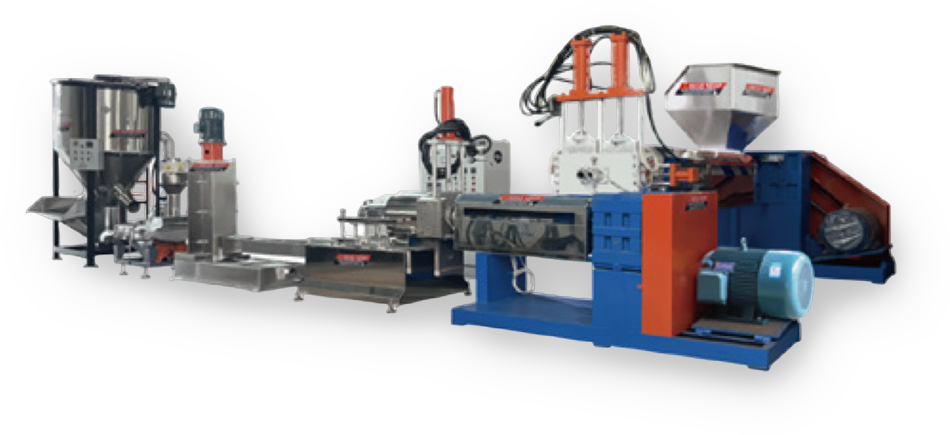
REHOBOTH offers multiple configurations to match different applications:
-
Single-screw models: Suitable for general-purpose recycling
-
Conical twin-screw models: Better for materials requiring intensive mixing
-
Parallel twin-screw models: High throughput and superior dispersion
The right choice depends on your material characteristics and output requirements.
Step 7: Plan for the Long Term — Scalability and Support
A one-stop factory plan should look beyond the initial installation.
Scalability considerations
-
Can the line be expanded to increase capacity?
-
Are there provisions for additional washing stages if feedstock quality changes?
-
Can the system accommodate new polymer types in the future?
REHOBOTH's systems are designed for easy integration with future planned production lines, giving you flexibility as your business grows.
Support and service
Equipment downtime is expensive. When planning your factory, consider:
-
Spare parts availability: Are critical components stocked locally or available on short lead times?
-
Technical support: Is remote troubleshooting available? What are the response times?
-
Warranty coverage: REHOBOTH provides comprehensive warranty services and long-term technical support
-
Operator training: Will the supplier train your team on proper operation and maintenance?
Checklist: Factory Planning Essentials
Before finalizing your factory plan, run through this checklist:
- Feedstock fully characterized (polymer type, form, contamination, moisture)
- Output specifications defined (purity, pellet size, application)
- Process flow mapped from receiving to finished pellets
- Floor plan designed with straight material flow and maintenance access
- Utility requirements calculated (power, water, compressed air)
- Environmental compliance requirements identified
- Equipment selected based on material compatibility, not just price
- Future expansion space allocated
- Spare parts and technical support arrangements confirmed
- Operator training plan in place
FAQ
1. What is the most important factor in planning a plastic recycling factory?
Your feedstock is the most important factor. Everything — equipment selection, layout, utility requirements, and budget — depends on what material you will process, in what quantity, and with what level of contamination. Start with a thorough feedstock audit before making any equipment decisions.
2. How much space do I need for a plastic recycling plant?
Space requirements vary significantly based on capacity, feedstock type, and whether you need washing stages. A typical line includes receiving area, storage, size reduction, washing (if applicable), granulation, pellet storage, and packaging. It is common to underestimate storage space — allow ample room for both raw material and finished pellets.
3. What is the difference between dry and wet granulation in factory planning?
Dry granulation (strand pelletizing) uses water for cooling only, while wet granulation (underwater or water-ring pelletizing) uses water directly at the cutting chamber. The choice affects your water supply, wastewater treatment, and drying requirements — all of which impact your factory layout and utility planning.
4. How do I choose between single-screw and twin-screw granulators?
Single-screw models are suitable for general-purpose recycling of most common plastics. Twin-screw models (conical or parallel) provide better mixing and are preferred for materials requiring intensive homogenization or when processing multiple polymer types. Your material characteristics and output quality targets should guide the choice.
5. What utilities does a plastic recycling factory need?
A recycling factory typically requires: three-phase power supply (total load depends on equipment capacity), water (for cooling, and washing if applicable), and compressed air (for pneumatic conveying and controls). If using hot washing or thermal drying, you may also need gas or steam. Plan for wastewater treatment if your process generates contaminated water.
6. How long does it take to set up a plastic recycling factory?
The timeline varies widely depending on scale, equipment lead times, site preparation, and permitting. A realistic estimate from planning to production is typically 6 to 18 months. The planning phase — feedstock assessment, layout design, and equipment specification — is often the most time-critical part and should not be rushed.
Conclusion
Planning a one-stop plastic recycling factory is not about buying the most expensive or the most feature-rich equipment. It is about matching your system to your specific feedstock and output requirements.
The key takeaways:
-
Start with your feedstock — not with a machine catalog
-
Define your output specifications before selecting equipment
-
Plan your layout for straight material flow and future expansion
-
Consider utilities and environmental compliance early, not as an afterthought
-
Evaluate equipment as an integrated system, not as standalone machines
-
Plan for long-term support — spare parts, technical service, and operator training
If you are in the early stages of planning and need to understand how different configurations might fit your specific material and production goals, reviewing the available system options is a practical next step.


 Download
Manual
Download
Manual Video
Video



 Connect: