Quick answer: The labels rA, rB, rC and rD describe four commercial quality tiers of recycled plastic pellets—commonly called prime, commercial, utility and regrind—but they are not defined in any ISO or ASTM standard. What actually separates them is a combination of melt flow consistency, moisture content, contamination level and filtration history. A grade label alone tells you very little; the test data behind it tells you whether the pellets fit your end market.
Why “Grade” Is Not a Standardized Term in Recycled Pellets
Virgin plastic resins are sold against published specification data sheets, usually traceable to ISO or ASTM methods. Recycled pellets operate in a different reality. A buyer asking three suppliers for “prime grade rHDPE” may receive three different materials, each with a different MFI value, moisture level and contamination profile, all carrying the same label. The grade vocabulary is commercial, not regulatory.
The practical implication is straightforward: you cannot compare recycled pellet offers by grade label alone. You have to compare the parameters that sit underneath the label. The rA–rD framework is useful only as a starting conversation tool, not as a substitute for a test report.
The Four Tiers in Commercial Practice
The table below synthesizes the grade expectations most commonly encountered in B2B recycled pellet trading. The thresholds are indicative ranges, not universal legal limits; actual specifications should be confirmed against a supplier’s test data and your own incoming inspection.
| Tier | Common commercial label | MFI/MFR consistency | Moisture | Contamination | Filtration level typically associated | Typical end markets |
| rA | Prime | ±5–10% of target | <750 ppm(film grade);<200 ppm for hygroscopic polymers such as rPET | <0.05% | Fine filtration, often ≤40–70 μm effective | Film, food-adjacent packaging(where certification allows), automotive, precision injection molding |
| rB | Commercial | ±15% of target | <1,500 ppm | 0.05–0.95% | Medium filtration | General injection molding, blow molding, pipe extrusion, non-critical film |
| rC | Utility | ±30% of target | <5,000 ppm | 0.5–2% | Coarser filtration | Construction pipes, drainage, agricultural items, industrial parts where color and odor are secondary |
| rD | Regrind / blend base | Uncontrolled or very wide | Variable | >2% possible | No or minimal melt filtration | Plastic lumber, low-spec moldings, blend carrier with virgin resin |
Source basis: indicative commercial ranges synthesized from industry grade frameworks and published recyclate quality literature; thresholds vary by polymer, feedstock and supplier.
Two nuances matter. First, rD is not always pelletized at all—it may be sold as regrind, in which case “grade” refers to a feedstock condition rather than a finished pellet specification. Second, a higher tier is not automatically the correct purchase. Over-specifying rA for a drainage pipe application adds cost without adding functional value; under-specifying rC for a thin-wall injection part may cause scrap rates that erase the raw-material savings.
The Parameters That Actually Define a Grade
If the rA–rD label is the headline, these are the body paragraphs. A grade claim that is not backed by data on the following parameters is an advertising statement, not a specification.
Melt flow consistency. MFI or MFR consistency is usually the first parameter buyers look at, but it is not the only one. A pellet batch with an average MFI inside the target range can still process poorly if batch-to-batch variation is wide. Consistency—expressed as a percentage deviation from target—is often more important than the absolute number for injection molding and film extrusion, where small flow differences change fill behavior and gauge uniformity.
Moisture content. Residual moisture causes splay marks, voids and, in hygroscopic polymers such as PET and PA, hydrolytic chain scission during melt processing. Film-grade and hygroscopic grades typically require tighter moisture limits than utility grades. This is one of the most common gaps between a supplier’s grade claim and actual incoming quality, and it is directly influenced by the drying and conditioning stages upstream of the pelletizer.
Contamination and gel count. Unmelted particles, gels and incompatible polymer fragments are not captured by an MFI test. They show up as surface defects, weak points or filtration pressure spikes. A grade that claims rB but has uncontrolled gel content may behave more like rC in a thin-film line. Buyers handling film or precision injection should ask for contamination data in addition to flow data.
Odor and volatile content. For automotive interiors, food-adjacent packaging and consumer goods, odor and total volatile organic compounds can disqualify an otherwise well-filtered pellet. Odor is not visible in a standard TDS, and it is one of the parameters where “prime” claims most often fail under actual testing.
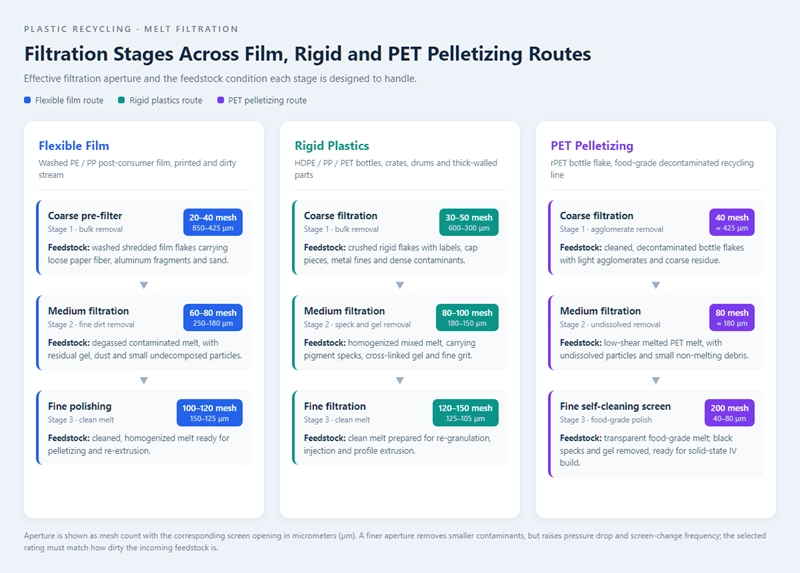
Filtration history. The effective filtration aperture used during pelletizing sets a ceiling on what contamination size can be removed. A line running coarse screens cannot reliably produce rA-equivalent pellets from a contaminated feedstock, regardless of the label applied afterward. Filtration is not a downstream cosmetic step; it is a grade-determining process decision.
Matching Grade to End Market: A Practical Matrix
The grade label becomes useful only when read against the intended application. The matrix below is a decision aid, not a certification rule. “Conditional” means the grade can be suitable if supporting test data confirms the specific requirement is met.
| End application | rA (Prime) | rB (Commercial) | rC (Utility) | rD (Regrind / blend) |
| Food / beverage packaging | Suitable with food-contact certification | Not suitable | Not suitable | Not suitable |
| Automotive interior / odor-sensitive | Suitable | Conditional—odor and VOC data required | Not suitable | Not suitable |
| Thin-wall injection / precision parts | Suitable | Conditional—MFI consistency and contamination data required | Not suitable | Not suitable |
| General injection molding(crates, bins, housewares) | Suitable | Suitable with incoming inspection | Conditional—color and impact requirements matter | Conditional as blend component |
| Blow molding(non-food HDPE bottles) | Suitable | Suitable | Not suitable | Not suitable |
| Agricultural film / packaging film | Suitable | Suitable | Not suitable | Not suitable |
| Construction pipe / conduit | Suitable | Suitable | Suitable | Conditional—typically as a blend fraction |
| Plastic lumber / low-spec industrial | Suitable but over-specified | Suitable | Suitable | Suitable |
Grade-to-application suitability is indicative and depends on polymer type, part design, wall thickness and local regulatory requirements. Confirm with application-specific testing.
A recurring mistake is to treat the matrix as a ladder and assume “higher is safer.” In practice, the correct grade is the lowest tier that reliably meets the functional requirements of the part, supported by incoming inspection. Paying for rA on a product that tolerates rC does not improve the product; it only changes the cost structure.
How Pelletizing and Filtration Configuration Set the Grade Ceiling
A recycler cannot promise a grade that the process is not configured to hold. The grade ceiling is usually determined by the weakest link among feedstock consistency, washing and drying performance, melt filtration and temperature control during extrusion.
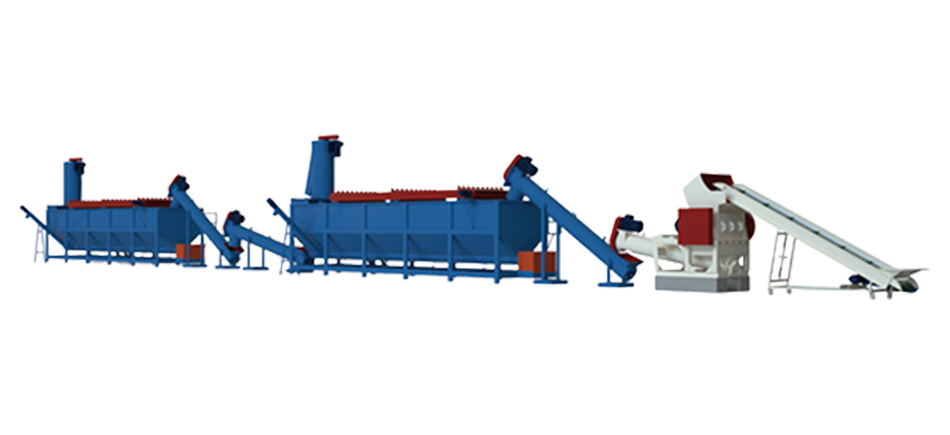
For film feedstock, stable feeding and effective degassing matter as much as filtration, because volatiles and moisture from printed or wet film can degrade the melt before it reaches the screen. For rigid regrind, particle consistency and contamination removal are the dominant concerns, and a pelletizer configured around sorted rigid regrind will have a different filtration and feeding strategy than a film line. For PET, moisture control and thermal history are central; a PET pelletizer designed for washed flakes addresses drying and IV control as part of the grade-determining process.
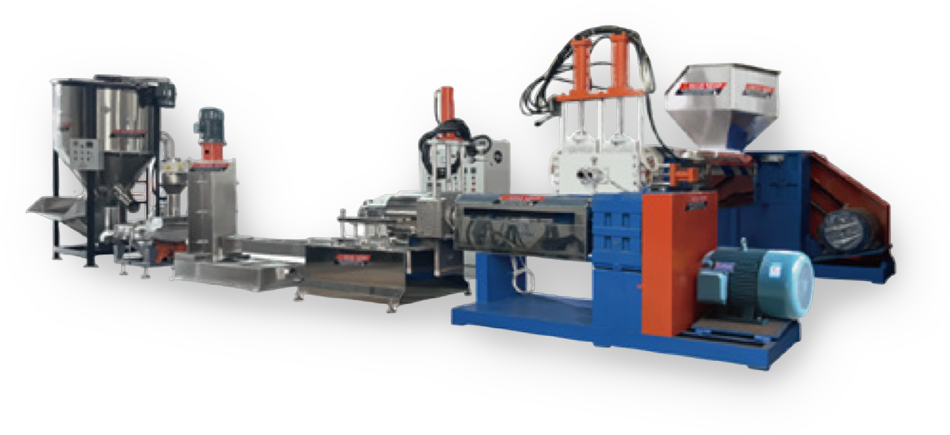
This is where equipment selection intersects with grade economics. Upgrading filtration and temperature consistency can shift a line’s stable output from one commercial tier to the next, but the correct configuration depends on the feedstock’s actual contamination profile and the target pellet specification—not on a universal “grade package.” Buyers planning a new line or a grade upgrade can review the available granulation system configurations and compare how film, rigid and PET routes differ in pretreatment, feeding, filtration and pellet cutting.
A Buyer’s Checklist for Evaluating a Grade Claim
Use this checklist before accepting a supplier’s rA–rD label at face value.
- Does the supplier state the polymer, feedstock type(PIR/PCR)and feedstock source? Grade claims without feedstock context cannot be compared across offers.
- Is MFI/MFR reported as an average only, or as a target ± tolerance? Consistency data is more useful than a single average value.
- Is moisture reported with the test method and the sampling point? Moisture measured at the pelletizer discharge may differ from moisture at the buyer’s silo.
- Is contamination reported as a total percentage, a gel count, or a filter pressure value? Each answers a different processing question; a total percentage alone may hide large particles.
- For film, thin-wall or odor-sensitive applications, is odor/VOC data available? If not, a “prime” claim is incomplete for those end uses.
- Does the supplier’s line configuration logically support the claimed grade ceiling? A coarse-filtration line claiming rA from a high-contamination feedstock warrants a detailed technical explanation.
- Can you run an incoming inspection batch before committing to volume? The first delivery is a sample, not a confirmation.
What to Do When the Grade Label and the Data Disagree
When a test report does not support the label, the useful move is not to argue about the tier name but to renegotiate against the parameter that matters for your process. If the issue is MFI variation, request lot-specific flow data and consider whether your process can tolerate blending. If the issue is moisture, verify drying capacity and packaging protection. If the issue is gels or contamination, ask about the effective filtration aperture used on the production run and whether a finer screen pack is technically feasible for that feedstock.
If you are evaluating a new recycling line or reconfiguring an existing one to target a specific commercial grade, the productive conversation starts with representative feedstock samples, the required pellet specification and the end-use requirements—not with the grade name alone. The granulation system selection page outlines the information needed to match pretreatment, feeding, filtration and pellet cutting to a target output condition, and the related material-specific routes for film, rigid regrind and PET provide a starting point for comparing configurations.
Conclusion
The rA–rD framework is a useful commercial shorthand, but it is not a standardized quality guarantee. The grade that matters is the one your incoming inspection can verify against the parameters your end market actually requires: MFI consistency, moisture, contamination and—where relevant—odor and volatile content. Avoid two symmetric errors: treating a grade label as a specification, and over-specifying a higher tier for an application that does not need it. When a supplier’s grade claim is ambiguous, ask for lot-level test data and, if you are planning equipment, discuss the target grade in terms of feedstock condition and filtration configuration rather than tier name.
FAQ
Are rA, rB, rC and rD official recycled plastic grades?
No. They are commercial tier labels used in recycled pellet trading, not standardized grades defined by ISO, ASTM or CEN. The underlying quality is determined by measurable parameters such as MFI consistency, moisture, contamination and odor, which should be verified through test reports.
What is the main difference between rA and rB recycled pellets?
In commercial practice, rA(prime)typically implies tighter MFI tolerance, lower moisture and lower contamination than rB(commercial), and is associated with fine filtration. rB is generally intended for less demanding applications where moderate variation is tolerable. The exact thresholds vary by supplier and polymer.
Can rC pellets be used for injection molding?
Yes, for non-critical injection-molded parts where color, odor and high impact strength are not primary requirements—for example, some construction or industrial items. Thin-wall or precision injection molding usually requires at least rB-equivalent consistency and contamination control.
Does a higher grade always mean better value?
No. The correct grade is the lowest tier that reliably meets the functional requirements of the end product with incoming inspection in place. Over-specifying rA for an application that tolerates rC adds cost without adding functional benefit.
What test data should I request to verify a grade claim?
At minimum: MFI/MFR with target and tolerance, moisture content with test method, contamination or gel data, and—for film, automotive or food-adjacent applications—odor/VOC data. Polymer type, feedstock source and effective filtration aperture provide the context needed to interpret those numbers.
How does the pelletizing line configuration affect the achievable grade?
The stable grade ceiling is set by the weakest link among feedstock consistency, washing and drying performance, melt filtration and temperature control. A line configured for a specific feedstock condition and filtration aperture can hold a tighter grade; a line without that configuration should not be expected to produce the same grade consistently, regardless of the label applied.


 Download
Manual
 Video




 Connect: