Last year, a mid-sized recycler in the Midwest spent nearly $400,000 extra on a new washing line. He’d asked for a system that could handle everything: heavily printed LDPE film, rigid HDPE crates, a bit of agricultural twine, and occasionally some post-industrial purge lumps. The supplier, happy to oblige, added extra friction washers, a hot wash cascade with chemical dosing, three separate density separation tanks, and a custom water treatment circuit. Six months in, the hot wash unit had never been heated above 40°C. Two of the density tanks ran plain water. The fancy additive dosing system sat in bypass mode because no one on the floor trusted the concentration sensors. The plant produced decent pellets, but the payback period had stretched from a planned 18 months to nearly four years.
This wasn’t a case of a bad machine. It was a classic case of over-specification, and it happens more often than most project managers care to admit. When you’re planning a plastic recovery operation, the urge to future-proof everything and cover every conceivable feedstock variant is powerful. But that urge, left unchecked, turns a lean, profitable asset into an over-engineered anchor.
Where the urge to over-specify comes from
Over-specification rarely starts with greed. It almost always starts with fear. Fear that the raw material stream will change. Fear that a single missed contaminant will ruin a batch of pellets and a customer relationship. Fear that a competing plant down the road can process a wider range of scrap. These fears are legitimate, but they lead project owners to write tender documents that read more like a wish list than an engineering specification.
We see RFQs that demand simultaneous processing of film, rigid, and fiber scrap in one line, with throughput guarantees that are mathematically incompatible with the proposed machinery size. We see requests for integrated optical sorters when the infeed material is already a single-polymer post-industrial stream. The result is a waste plastic cleaning and granulation recycling system that performs several tasks adequately and none exceptionally, with a capital expenditure figure that terrifies the finance team.
The root cause is a lack of data-driven specification. Instead of starting with a month’s worth of sorted, weighed, and moisture-analysed input samples, decisions get made based on “what the market might need in three years.” That’s speculation, not engineering.
Focus on the material, not the machine catalog
The most effective specification exercise you can do doesn’t involve a single equipment brochure. It involves a sturdy table, a weigh scale, a moisture analyzer, and a few hundred kilograms of your actual feedstock. Classify your input material across four non-negotiable dimensions:
-
Polymer type and mix ratio – Are you running 100% LDPE film, or a 70/30 mix of PP and HDPE rigid? Each target demands a completely different washing and granulation philosophy.
-
Contaminant profile – What is the real percentage of paper labels, adhesive, sand, organics, and metals? A high-paper fraction might demand a dedicated cold wash with aggressive friction before any hot stage, while heavy organics require a completely different water filtration strategy.
-
Bulk density variance – Film, regrind, and rigid flakes behave very differently in conveying, washing, and drying stages. A line optimized for film will choke on rigid flake unless the water handling and screw presses are sized for the heavier material.
-
Target pellet quality – Are you aiming for a filtration level of 150 microns for black pipe extrusion, or 80 microns for thin-film blowing? The granulation and melt filtration stages must be designed backward from this specification, not added as an afterthought.
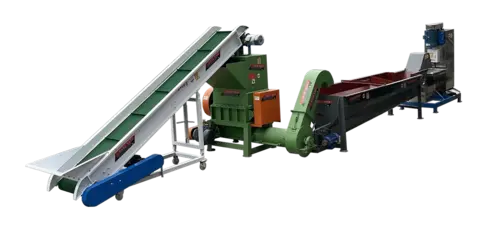
Once you have this data, the specification tightens naturally. You may realize that your “mixed rigid and film” idea adds a six-figure cost for flexibility you’ll use twice a year. At that point, you can make an economic decision: is it cheaper to buy a dedicated film line and outsource those two annual rigid jobs, or to accept the complexity? Almost always, the numbers favor a clearly focused line. An integrated approach that combines washing and granulation in a single, well-matched sequence — rather than a patchwork of over-engineered sub-systems — consistently delivers a faster return. For operators looking to avoid the capital trap, the key is to evaluate the complete process from dirty bale to filtered pellet, not just the flashy individual components. Learn how a purpose-built system for post-consumer film and rigid scrap can match your feedstock reality.
The hidden cost of “just in case” features
Every piece of equipment you add to a line carries a compounding cost. It’s not only the purchase price and installation. It’s the additional energy consumption, the spare parts inventory, the extra sensors that need calibration, the operator training burden, and the maintenance downtime that increases non-linearly with system complexity. A 2018 study by the European plastics recycling association PRE estimated that maintenance-related downtime in over-specified recycling lines could account for 11–15% of available production hours, compared to 5–7% for lines designed with a clear material focus.
Then there’s the quality paradox. A flexible system often achieves lower average quality than a dedicated one. When your hot wash temperature, residence time, and water chemistry are set for a “general” recipe, you are sub-optimal for every specific material. A LDPE film that needs 85°C and 2% caustic solution to remove heavy printing will exit a 60°C general wash with residual ink, dragging down pellet value. The line has the feature to heat to 85°C, but the operator, pressured to minimize energy costs and changeover time, never uses it. You paid for capability that sabotages your product.
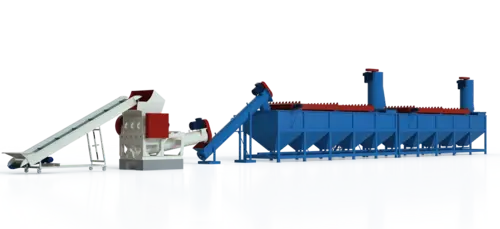
The alternative is to design for the rule, not the exception. If 90% of your feedstock is LDPE stretch film, specify the washing and granulation stages for that material, and install a small parallel side stream — or a manual bale sorting station — for the remaining 10% rigid contamination. This approach keeps the primary waste plastic cleaning and granulation recycling system lean and efficient while still handling outliers without choking the main process. Avoid the temptation to turn your main production line into a Swiss Army knife.
A practical specification checklist
When you’re putting together your next RFQ or internal capital request, run through this checklist before you speak to any supplier. It’s built from dozens of plant audits and will save you more than any glossy brochure.
-
Feedstock log completed? At least 20 representative bales from different suppliers, sorted and analyzed for polymer type, moisture, and contamination by weight.
-
Throughput defined at the bottleneck? Specify the minimum acceptable dry, clean flake output, not just a theoretical infeed capacity. Washing efficiency and drying determine true throughput.
-
Water treatment matched to local discharge limits? A fine-screen filter may be enough; a full dissolved-air flotation system may be overkill. Test your wash water from a pilot run.
-
Granulation integrated with washing thermal budget? Hot washing often raises flake temperature; a granulator placed after the hot wash instead of before can save energy and reduce fines.
-
Control philosophy stated? If you don’t need automated recipe switching, don’t pay for it. A simple PLC with manual temperature setpoints and level controls is often more robust.
-
Future expansion points defined, not guessed? Decide where in the line you would add a second extruder or extra washing stage, and ask the supplier to flange that point. Don’t buy the equipment now.
If a supplier can’t answer these points with specific references to your material data, they’re selling a catalog, not a solution. When you are ready to move from checklist to concrete configuration, explore a modular, data-driven approach to plastic washing and granulation that puts your material first.
When expert guidance saves more than it costs
An experienced process engineer who has witnessed ten over-specified lines struggle to hit nameplate capacity can condense that learning into a single hour of consulting. In one recent project, a plant manager was about to sign off on a €1.2 million line for mixed polyolefin rigid scrap. A third-party review of the feedstock data revealed that the “mixed” stream was actually 92% PP bottle caps with consistent melt flow and minimal PE contamination. The line was re-specified to a much simpler cold wash, grinder, and single-screw extruder with screen changer. The cost dropped to €680,000, and the pellet quality actually improved because the process was no longer fighting a “general purpose” compromise.
This is not an argument against ambition. It’s an argument for precision. The most successful recycling plants are not the ones with the longest equipment lists. They’re the ones where every motor, every pump, and every heating element has a clear, data-backed reason to exist. When you walk through such a plant, nothing feels bolted-on or abandoned. The complete cleaning and granulation circuit hums at a steady state, and the operator can explain exactly why the third friction washer isn’t there — because the material didn’t need it.
If you’re building or upgrading a facility, the best investment you can make is in the upfront characterization work and in choosing a partner that pushes back on unnecessary complexity rather than simply adding line items. A truly optimized waste plastic cleaning and granulation recycling system isn’t the one with the most features — it’s the one where every feature pays for itself within the first year of operation. Get a configuration review tailored to your actual material stream and output targets.
*This article draws on operational data from multiple plastic recycling facilities and references the CEN/TC 261 packaging and waste management standards. All examples are anonymized to protect commercial confidentiality. Equipment specifications should always be validated with pilot trials using your own feedstock.*


 Download
Manual
Download
Manual Video
Video



 Connect: