Your customer just rejected a full truckload of recycled LDPE pellets. Photos show film with pinholes, gels, and black specks – classic signs of contamination. You’re looking at a return freight bill, a production line standing idle, and a bruised reputation. The pellets met melt flow specs, so what went wrong? The answer almost always sits upstream of the pelletizer, hiding in washing efficiency, filtration step design, and moisture control. Getting consistently clean pellets isn’t about working harder at the end of the line; it’s about rethinking what happens before the plastic ever reaches the die face.
Why “Good-Looking” Flakes Still Produce Bad Pellets
Many recycling operations still evaluate their output by visual flake cleanliness. A flake can look spotless and still carry a microscopic film of adhesive residue, a trace of paper fibre, or volatile substances absorbed during its first life. When that flake melts, the hidden contaminants turn into charred particles, gas bubbles, and gel clusters. Add in the fine metal particles from worn shredder blades or the silica dust from poorly rinsed materials, and you get exactly the black specks that screen packs choke on – and that film converters hate.
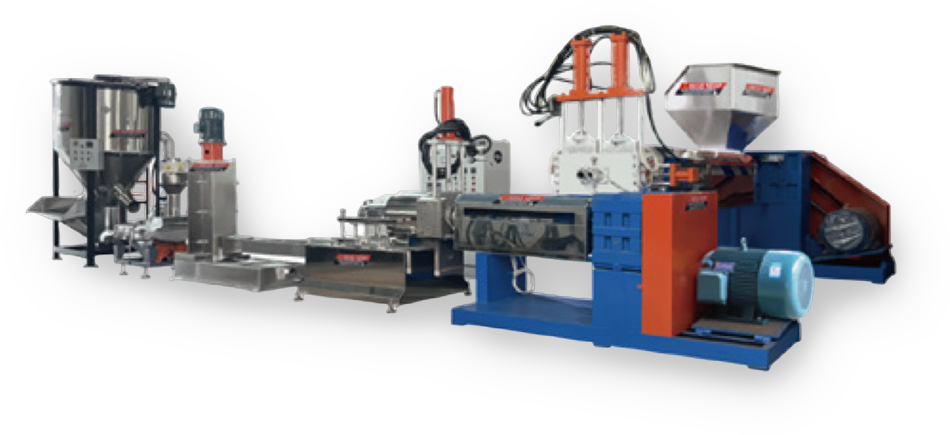
The economics are brutal: contaminated pellets can sell for 20-35% less than clean near-virgin grades, and in some cases are only useful as filler. The problem isn’t solved by adding another melt filter, though that helps. It’s solved by recognizing that pellet quality is a whole-system outcome, which is why a purpose-built waste plastic recycling and granulation system becomes essential when you want to move from low-value scrap recovery into high-margin engineered recyclates.
Three contaminants account for over 80% of pellet quality claims, and they each demand a specific countermeasure:
-
Organic residues (adhesive from labels, food waste, printing ink binders): not removed by cold washing alone.
-
Solid particulates (sand, glass shards, metal fines, paper pulp): survive many standard wash stages.
-
Trapped moisture and volatiles: cause porosity, bubbles, and hydrolytic degradation during extrusion.
The Process Fix: A Stage-by-Stage Contaminant Removal Map
1. Pre-wash and Density Separation – Catch the Heavy Dirt Early
Before material reaches the friction washer, it should pass through a pre-wash tank with a high-turbulence zone that detaches abrasive grit and dissolves water-soluble glues. Integrating a sink-float separation stage right here removes stones, glass, and metal pieces that would otherwise chew up screw and barrel downstream. For film lines, adding a paddle-type pre-washer ahead of the main wash can reduce dirt carryover by nearly 40% – a number many operators only appreciate after they measure the sludge in their centrifuge.
2. Hot Washing and Friction Cleaning – Tackle the Adhesives
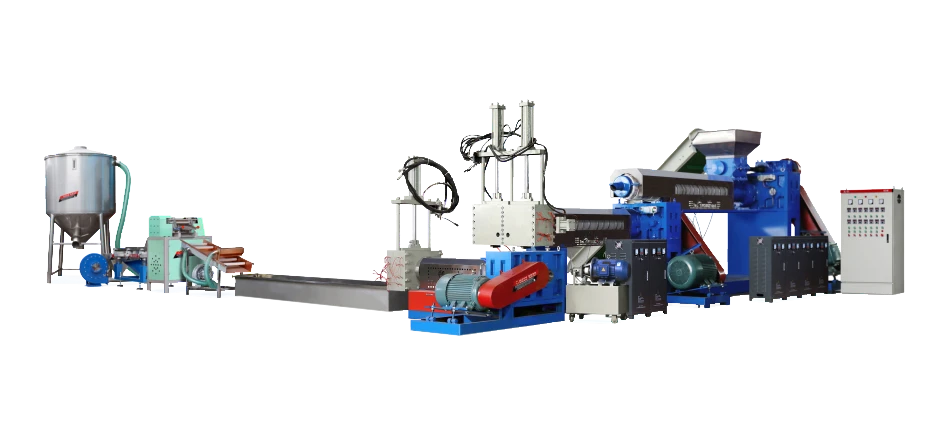
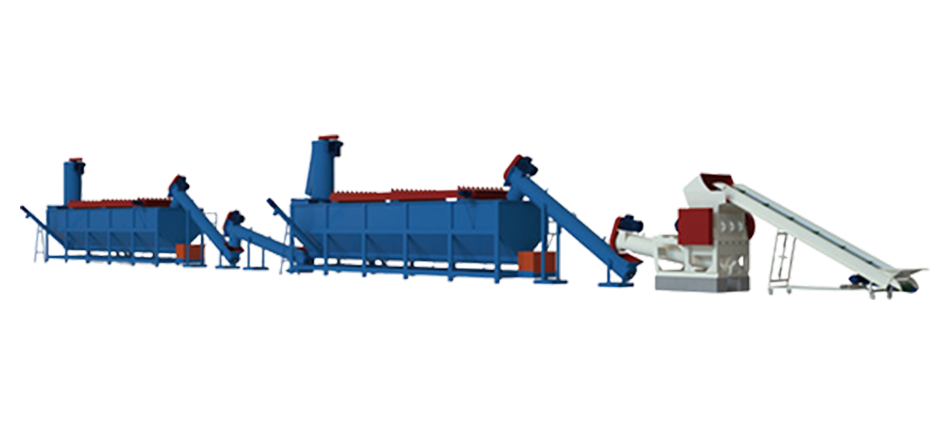
Cold washing won’t soften pressure-sensitive labels or hotmelt glues. A dedicated hot wash module, held at 65–80°C with a controlled caustic dosing system, swells and releases these sticky residues. Immediately following it with a high-speed friction washer provides the mechanical energy to scrub the last remaining impurities from the flake surface. This sequence – hot wash plus friction – is the single most impactful upgrade for post-consumer rigid and film lines. Without it, adhesives carry through to the extruder, degrade into black specks, and no amount of melt filtration can fully salvage the batch. A modern system like an advanced washing and pelletizing line ties these units into a continuous, water-recirculating circuit that keeps process parameters stable shift after shift.
3. Rinse, Dewater, and Control Residual Moisture
Carryover of process water into the extruder is a silent pellet-killer. Wet flakes need more thermal energy to melt, but the bigger issue is that water vapour creates micro-voids in the pellet and accelerates polymer degradation inside the barrel. Target a residual moisture of below 5% for flakes entering the agglomerator or extruder hopper, and below 0.3% for the final pellet if you’re targeting film or fiber grades. Mechanical centrifugal dryers, combined with a thermal drying stage where needed, should be treated as a process-critical step – not an afterthought. For sensitive applications like extrusion coating or blow molding, an additional vacuum degassing zone in the extruder is non-negotiable.
4. Melt Filtration – Your Last Defence Against Black Specks
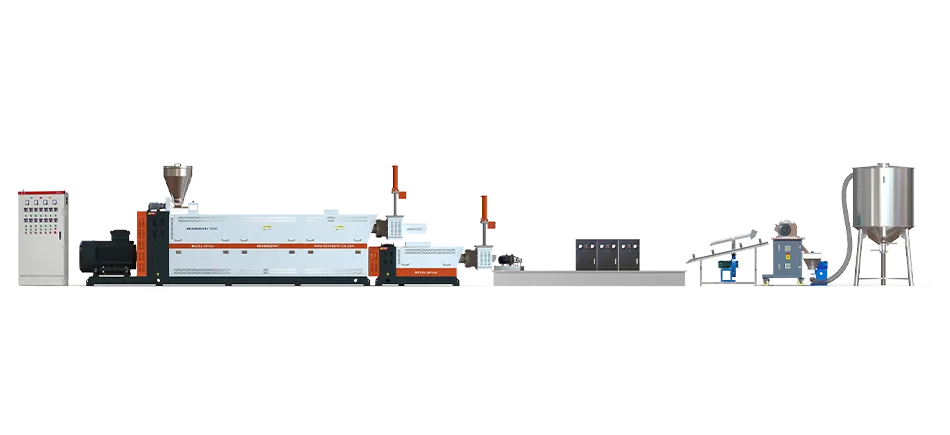
Even a perfectly washed flake can carry trace particles. That’s where the melt filtration stage earns its keep. For rigid regrind, a dual-piston or backflushable continuous screen changer with laser-drilled filter elements (down to 150 mesh for PP/PE, 200+ mesh for PET) catches particles above 70–100 microns. If you’re still running a manual screen changer, black specks are inevitable: every screen change dumps built-up degraded material into the melt stream. A multi-stage filtration and degassing system that pairs a coarse breaker plate with a fine-mesh secondary screen, followed by an active vacuum degassing port, routinely delivers pellets that pass film extrusion tests with zero visible defects per square meter.
5. Strand Cooling and Cutting – Preserve Quality to the Last Step
Freshly cut pellets are still hot enough to fuse together if cooling water isn’t properly temperature-controlled. Water that’s too cold quenches the strand surface too fast, trapping internal bubbles; water that’s too warm leaves pellets sticky. Maintain strand bath temperature at 20–30°C for PE and PP, and use a dedicated pellet dryer post-cutting to strip surface moisture before pellets enter the storage silo. Oxygen exposure at elevated temperature also triggers yellowing – minimizing the pellet’s time above 60°C preserves colour and mechanical properties for downstream processing.
Small Upgrades That Deliver Disproportionate Quality Gains
Beyond the big-ticket equipment, several operational adjustments have an outsized impact on pellet consistency. These come from years of troubleshooting on working lines:
-
Shredder blade maintenance: dull blades create excessive fines that burn in the extruder. Check blade gap weekly; replace sets when throughput drops 10%.
-
Steady feeding: a gravimetric feeding bridge breaker eliminates surge-feed conditions that cause pressure fluctuations and inconsistent melt temperatures. Consistent melt equals consistent pellet weight and shape.
-
Filter timing: don’t wait for the pressure alarm before changing screens. A schedule-based change cycle (e.g., every 4 hours for heavily printed film) cuts the carbonized speck load far more effectively than reactive changes.
-
Water quality management: recycled wash water accumulates dissolved organic acids that etch metal surfaces and re-deposit on flakes. Maintain a 15% fresh water makeup rate and monitor pH.
A Plastics Recyclers Europe technical report notes that for every 0.1% reduction in pellet moisture, downstream film producers see a 12–18% reduction in bubble instability defects. That data point alone reframes drying from a cost item into a quality investment.
When Standard Pellets Aren’t Enough
If you’re chasing high-value applications – blow-moulded containers, contact-sensitive packaging, or high-tenacity fibres – then meeting general-purpose pellet specs won’t cut it. These markets demand pellets that can be processed without odour complaints, without gels forming on calender rolls, and with colour stability that survives multiple heat histories. Achieving this requires a fully integrated approach where the washing section, extruder, filtration, degassing, and pelletizing unit are engineered as a single closed-loop quality system, not a collection of standalone machines. Some processors start with a basic line and later try to retrofit filtration upgrades; the more cost-effective path is usually to check the complete system configuration upfront, ensuring every module is sized and sequenced for the intended feedstock and end-market specification.
If you’ve been battling contamination issues and want to move from reactive troubleshooting to a stable, repeatable process, consider studying rehoboth’s approach to clean pellet production. It’s built on the same principle this article describes: that pellet quality is made in the wash line and the melt path, not just at the die. The specific solution will always depend on your feedstock mix, throughput requirement, and end-product goals – but the contaminant removal map above gives you a universal checklist to evaluate any line, existing or new.
Disclaimer: This article provides general process guidance based on industry best practices and third-party technical reports. Actual results depend on feedstock characteristics, operating conditions, and maintenance protocols. Always consult equipment-specific documentation and conduct trials under your production conditions.


 Download
Manual
Download
Manual Video
Video



 Connect: